

- Article

- Support
- Economic Reports
The UK’s economic and fiscal challenges
The UK’s economic and fiscal challenges are closely connected. The Government’s ability to tax, spend and borrow sustainably depends partly on the long-term strength of the economy, while decisions on public spending, borrowing and investment can also shape future growth.
For businesses, the state of the public finances can influence borrowing costs, consumer demand, tax policy, investment incentives and confidence in the wider economy. This article explores the structural forces shaping the UK’s economic outlook, the trade-offs facing policymakers and why credible, well-designed fiscal policy matters for long-term growth.
Key Takeaways:
- The UK’s public finances are closely linked to the economy’s ability to achieve sustainable economic growth over time.
- Weak productivity growth has contributed to constrained improvements in living standards and limited the growth of tax revenues.
- Higher government debt and debt-interest costs leave the public finances more sensitive to changes in inflation and interest rates.
- With debt around 95% of GDP, the UK’s public finances are more sensitive to changes in inflation and interest rates, pushing up debt interest costs (3.5% of GDP in 2025).
- Rising demand for health, social care, pensions, and defence spending creates difficult trade-offs including the need to invest in long-term growth.
- Economic shocks can create lasting fiscal “scars” by weakening the economy’s productive capacity and increasing debt relative to GDP.
- For businesses, credible, well-designed and predictable fiscal policy can support confidence, investment, and in turn support public finances.
Why do UK public finances matter for businesses?
The government faces demand for greater spending on areas ranging from healthcare and defence to infrastructure, while also trying to improve living standards, and keep the public finances on a sustainable path.
Meanwhile, for businesses, the health of the UK’s public finances carries both an indirect and direct impact - the former via the cost of borrowing, strength of demand, and the degree of certainty and confidence in an economy, and the latter through changes to taxes and subsidies.
Why is sustainable economic growth important for UK public finances?
The ‘best’ way to improve the public finances is not necessarily to raise tax or cut spending, but to grow the economy. A larger ‘pie’ generates higher household incomes and company profits, generating greater tax revenue without the need to change tax policy.
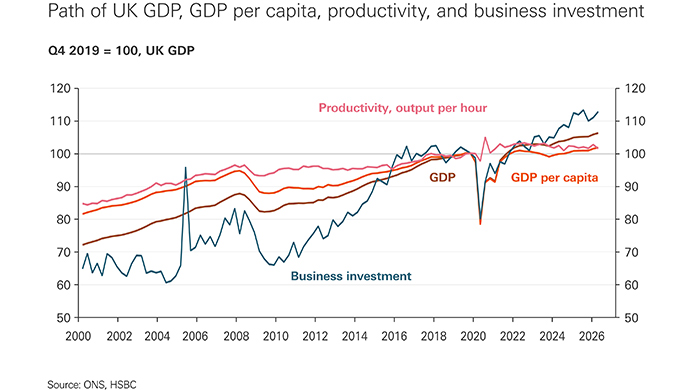
The UK’s difficulty is that growth has been relatively weak. The OBR expects real GDP growth of 1.1% in 2026 and 1.6% in 2027. That is a long way from the 2.3% average growth achieved between 1994 and 2010. Although aggregate growth only tells part of the story, population growth means annual GDP per capita has averaged just 1.0% since 2010. Meanwhile low wage growth, price increases – particularly since 2021 – and fiscal drag (the freezing of tax thresholds), have all weighed on real disposable income growth and limited improvements in living standards.
UK GDP, GDP per capita, productivity and business investment
Why has UK productivity growth been weak?
Behind much of the UK’s growth challenge lies weak productivity growth. The reasons are much debated, but weak investment, infrastructure constraints, high energy costs, and ability to innovate and adapt to changing technologies, are all part of the discussion. Notably, real business investment in the UK flatlined between 2016 and 2022, though productivity growth had flatlined long before then.
Ultimately, a more productive economy can grow without generating inflation, while also improving the fiscal position. The OBR estimates that if productivity growth were to average 0.5% annually - a rate similar to that seen over the 2010s – rather than their forecasted 1.0% annual growth, borrowing would be GBP40bn higher in 2030/31.
Looking ahead, productivity growth will become increasingly important against a backdrop of an ageing population and elevated economic inactivity. A potential partial offset to that: the UK and global economy are experiencing a technological revolution through AI, but its ability to positively impact productivity growth on a sustained basis will depend on its adoption and diffusion through the economy. AI alone may not be enough to solve the UK’s productivity puzzle.
How could stronger productivity growth improve public finances?
The UK has also had to navigate an unusually frequent succession of large economic shocks. The global financial crisis, pandemic, energy shocks related to geopolitical tensions, and trade disruptions have all been very different shocks but with one important commonality: their detrimental impact on the supply capacity of the economy.
Supply shocks are harder than demand shocks for a government to address. Firstly, measuring supply capacity is difficult and done with long lags. Meanwhile, a government needs to distinguish temporary versus structural changes to supply, and even then, any solutions are often slow to bear fruit. For example, building infrastructure or reskilling workers. Therefore, global uncertainty that weighs on supply growth, not only weighs on living standards in the near-term, but can damage an economy’s growth in the medium term.
From a fiscal perspective, if a government has sought to cushion the impact for households and businesses but poor growth is prolonged, the shock creates fiscal scars (e.g. a higher debt-to-GDP ratio) and weakens its fiscal resilience to future shocks.
How have economic shocks affected the UK economy and public finances?
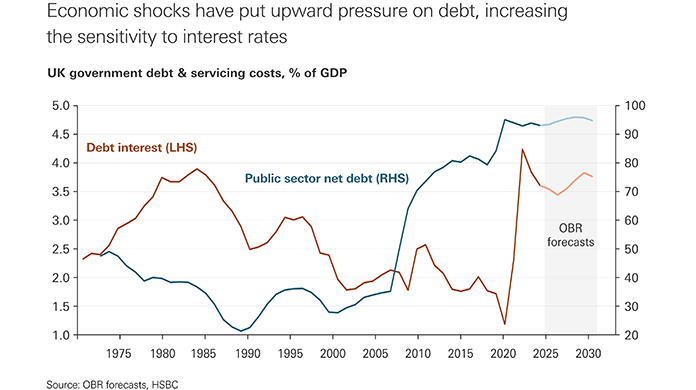
UK government debt is currently around 95% of GDP, compared to 35% in 2006 and 80% in 2019. A high debt level is not by itself a problem (see Let’s talk about debt, government debt, November 2025) but it does increase the sensitivity of the public finances to inflation and interest rates.
In recent years, the cost of servicing that debt has become more expensive, rising to 3.5% of GDP in 2025 from 1.7% in 2019. And because debt interest forms part of current expenditure, it can make it harder to balance the current budget – the government’s main fiscal target – without higher revenues or restraint elsewhere. Put another way, a greater share of government receipts is needed to service debt rather than being used to improve growth and living standards.
How economic shocks have increased UK debt and sensitivity to interest rates
At the same time, pressures on government spending are rising, from health and social care, pensions, and defence. Not only do these needs compete with existing spending pressures but they can also compete with the investment needed to support supply-side growth in the economy.
This creates a difficult balancing act. Maintaining credible public finances is important for confidence and borrowing costs, but addressing the UK’s structural growth constraints requires investment which could take years to materialise into higher productivity or supply capacity.
In addition, short political and fiscal horizons relative to an economic cycle, add another layer of complexity. Successive governments have contended with the upfront fiscal cost needed for investment – a challenge that becomes more pertinent as the debt level and debt servicing expenses rise – while resulting economic gains from investment are often not reflected within the time horizon of the fiscal rules or in time for the next election. That, alongside political decisions, has contributed to a lack of consistency in policy making and a sense of prolonged uncertainty for businesses.
The challenge therefore is to set policy that creates sufficient fiscal space to absorb future shocks, while also boosting productive capacity (the potential growth rate) and give businesses certainty. All achieved in a way that fits with the tenure of the fiscal rules and, albeit to a lesser extent, the parliamentary term. Not an easy task.
What do the UK’s economic and fiscal challenges mean for businesses?
For businesses, perhaps the most important aspect is credible, well designed fiscal policy which provides stability and policies that support businesses to invest and grow with confidence. That in turn, helps improve the public finances via growth.