

- Article

- Support
- Economic Reports
Do ageing populations matter for an economy?
Ageing isn’t just a social trend - it’s a macroeconomic one. Key takeaways: labour supply constraints can drag on growth without productivity gains; demographic shifts may push interest rates and inflation in new directions as retirees spend more and save less; and fiscal pressure builds as age-related spending rises while tax receipts soften.
The economic impact of an ageing society
Across much of the world, people are living longer and having fewer children and that means populations are ageing. In many economies, the number of retirees is set to rise by c2-3%, while the working age population (20-65 year olds) is set to be flat, see chart. That shift is often seen as an economic headache with uncertain but potentially significant impacts on growth, inflation, interest rates, and a government’s public finances. But what are those economic implications and are there any silver linings?
Growth potential could struggle without productivity gains …
Potential growth depends on an economy’s main inputs – labour, capital and productivity. As populations age, labour supply can become constrained as the share of non-working age people rises relative to those of working age. That in part can be mitigated against by people working longer. In fact, labour participation, globally, for the over 65 year olds has risen steadily over the last 20 years. However, in the absence of policy changes, that trend will have its limits and the effect will start to wane overtime.
Productivity is harder to call. Ageing can weigh on productivity if investment slows, if incentives to retrain weaken as retirement approaches, or if experienced workers exit faster than younger workers can build skills. Although, the evidence is mixed. A population ages gradually, the recognition of that trend can spur greater innovation, higher levels of education, improved health and rapid technology adoption, all of which boost productivity.
… pushing down on interest rates
In the long run, ageing can shift the “neutral” interest rate - the rate that neither boosts nor restrains the economy (it is not directly observable but widely estimated and used by central banks as a guide for setting policy).
For decades, ageing populations have placed downward pressure on the neutral rate of interest. Higher precautionary savings, in anticipation of long retirements, demand for assets, and plentiful supply of capital has put downward pressure on rates.
But that dynamic may not last. As retirees slow their rate of savings, and even draw down on those savings, and are replaced by relatively fewer working age savers, aggregate savings may fall, which would place upward pressure on the neutral interest rate. At the same time, government spending pressures on pension and healthcare places upward pressures on borrowing and subsequently interest rates.
Populations are changing rapidly and could mean significant economic change
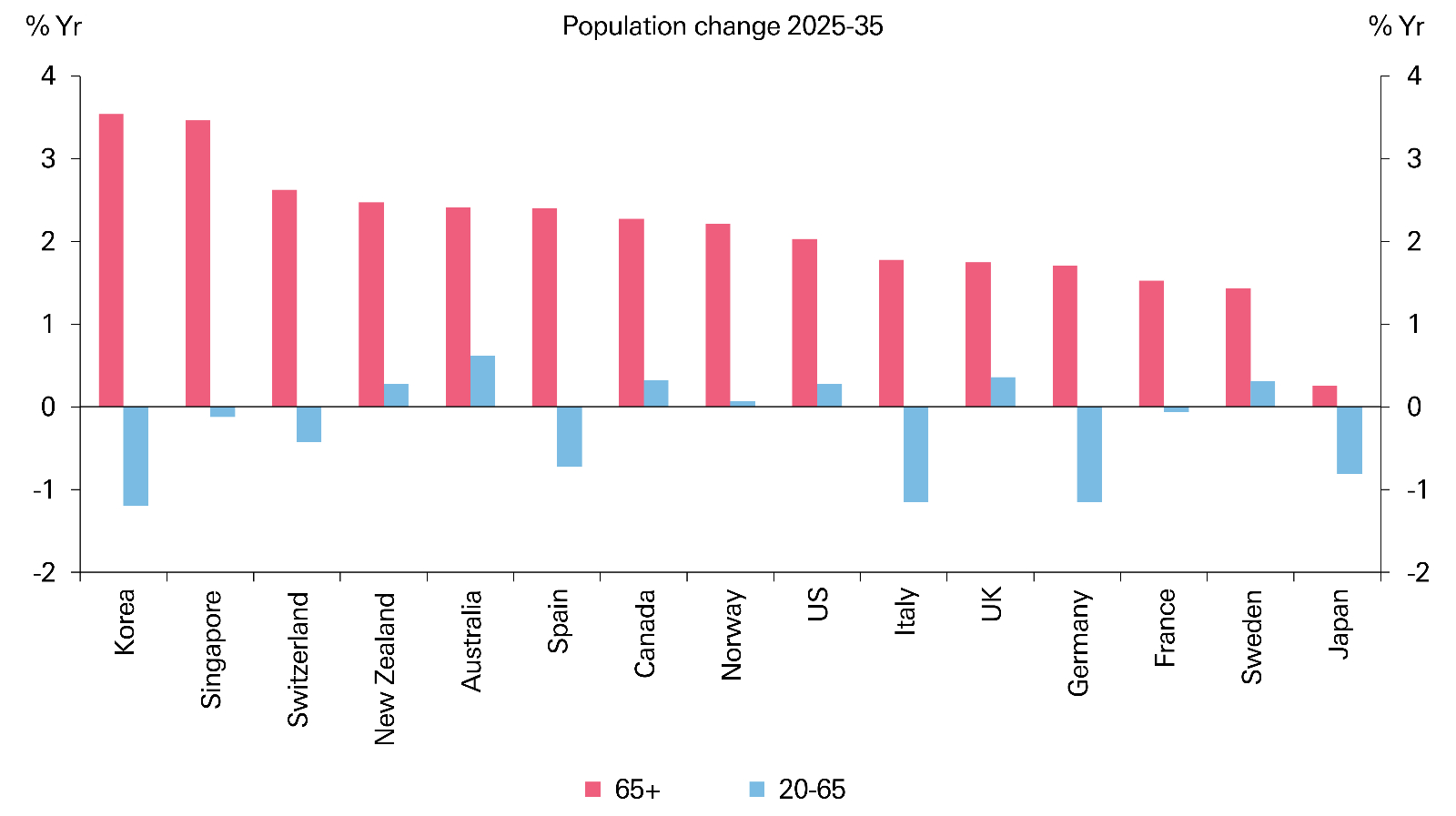
Inflation and wage dynamics shift …
Inflation may average higher over the long term, particularly if recent consumption patterns persist. Spending by the older cohorts has been strong and HSBC Global Investment Research has estimated that older cohort’s spending growth could average 4% annually. As such the ‘silver economy’ – age related goods and services - has seen a boom, with greater demand for healthcare, financial and estate planning, and leisure travel. On balance, older cohorts can be inflationary given they still support demand while simultaneously contributing less to the supply capacity of an economy. See HSBC’s economic report on why ageing populations may prop up consumer spending, from 3 June 2026.
For wage growth, as the baby boomer generation retires labour shortages may become more acute. And without sufficient improvements in productivity, which for the UK has proven difficult, or adequate immigration, labour shortages can result in upward pressure on wages. Most notably in highly skilled sectors where experience is essential.
… while pressure on a government’s public finances tightens
Changing demographics also create challenges for the public finances. In Europe, the share of the population that is over-65 years old is expected to rise from 20% today (up from 8% in 1950), to c30% by 2050. That shift will see structurally higher spending on pensions, healthcare and adult social care. In the UK, the OBR estimates that 0.6 percentage points of annual healthcare spending growth will come purely from an ageing population. Meanwhile, the working-age income tax base shrinks and consumption patterns of retirees can move away from VAT revenue generating areas.
With birth-rate or migration fixes either slow or politically constrained, governments face a narrowing set of choices: to raise taxes or cut other spending, enact unpopular reforms (notably higher retirement ages and/or less generous or means-tested pensions), or accept persistently higher deficits and debt, increasing the risk of fiscal instability (see An Ageing Dilemma, 13 August 2025). The extent to which higher debt to fund an ageing population is sustainable will depend on the balance of impact between interest rates and growth. See our Economy 101 piece on government debt sustainability.
Overall, ageing populations affect growth, inflation, interest rates and fiscal policy in ways that are tightly linked, and highly dependent on policy and changing individual preferences. And while, so far, it has been a slow-moving trend, the pace and impact has started to pick up. One thing is clear, ageing populations will be a defining feature of the global economy for the decades to come.