
- Article
- Support
- Economic Reports
How does an energy price shock impact an economy?
An energy price shock acts as a powerful negative supply shock to an economy. Its impact transmits via several interconnected channels, affecting households, firms, and policymakers. In a highly interconnected but uncertain global economy, understanding these pass-through channels can help businesses manage and mitigate the risk and spillover risks such as changes in policy or supply disruption.
Energy price shock – the impact on the economy
In its broadest sense, an external price shock can be understood through the lens of a negative supply shock. A rise in energy prices increases a firm’s marginal costs which results in higher prices for lower output. At the same time, higher energy prices have a direct impact on the rate of consumer price inflation while also weakening household consumption growth. In severe cases, a recession can ensue. And indeed, how policymakers choose to respond, or not, can amplify or propagate the impact of an energy price shock.
- For households, higher energy prices act like a tax, with the effect particularly pronounced for lower-income households, who spend a greater proportion of income on energy. Moreover, with demand for energy largely insensitive to changes in price, the damage to real incomes is often more visible through demand weakness in other areas of household expenditure.
- For businesses, as a core input into production for many sectors, higher energy prices leave firms facing difficult trade-offs. Firms can either pass the costs on or absorb the higher costs at the margin, although a mix of the two is more likely. In some cases, production may be scaled back, investment decisions delayed, or headcount reduced. Meanwhile, for sectors less exposed to an energy price shock, the damage to demand within the economy can be the greater concern.
- An external price shock is a difficult situation for a central bank. A stagflationary environment complicates monetary policy as raising interest rates to curb inflation may exacerbate the growth slowdown. Moreover, despite their main objective being to keep inflation on target, interest rates are not an effective tool to influence global energy prices directly. Such that, regardless of any change in interest rate policy, energy will directly push up on a country’s rate of inflation and therefore interest rates do not tend to rise in response to energy price shocks.
With that said, the response of households and businesses can influence inflation dynamics and, in turn, the interest rate policy response. Firstly, indirect inflation effects arise from higher production costs passing through into prices (for example, a restaurant passing on the cost of a higher electricity bill by raising the prices on its menu).
And then, of greatest concern to a central bank, is the extent to which a period of higher inflation induced by an energy price shock dislodges expectations. If households and firms begin to expect persistently higher inflation, wage demands and price setting behaviour can change, embedding inflation into an economy. This is often coined ‘persistent’ inflation.
How a government responds is key
Governments have more ‘tools’ at their disposal in responding to an energy shock. Fiscal policy can be aimed at the immediate price impact or boosting the energy related supply-side of the economy, albeit at great upfront cost. In the first instance, measures are aimed at mitigating the price impact on households and businesses e.g. subsidies or tax cuts. But while the primary aim of such interventions is to stabilise consumption or limit the margin suppression on firms, those policies can complicate the economic ‘response function’.
For example, protecting households against an energy price shock can influence inflation dynamics by limiting the impact on real incomes and consumption. As such, greater demand relative to that without government intervention, can enable firms to pass more of their energy price shock on to consumer prices, reinforcing those indirect inflation dynamics. In turn, if demand is supported, households may have greater ability to demand higher wages. Both of which place upward pressure on interest rates, that at least partially, offsets the impact of the government policy. It can be beneficial to allow demand to respond to higher prices, particularly if the shock is driven by reduced energy supply. In extreme cases, keeping demand artificially high through subsidies could lead to power cuts and rationing, as well as being very costly.
With that in mind, governments must carefully decide what support is appropriate to help agents in an economy versus stoking inflationary pressures. The type of policy, how long should help be available, and the scale and how targeted the support should be are all key. More broadly, the question of how support will be funded, and what trade-offs will be required, is also important. Notwithstanding the challenges, governments can, and often do, look to protect their economy by way of temporary, and often targeted support.
Overall, energy price shocks are inherently stagflationary, but their persistence and severity are contingent on how agents within an economy respond, including policy decisions.
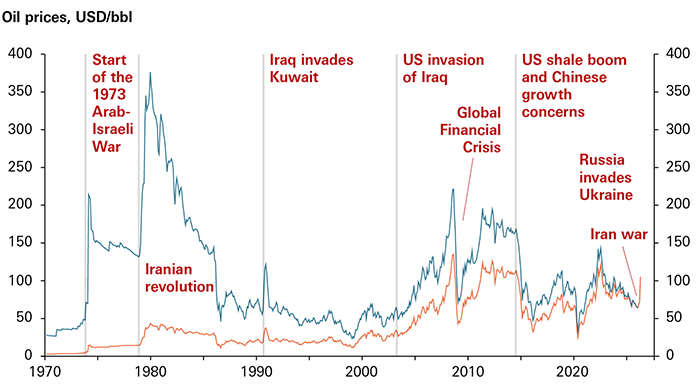
Swings in energy prices are a relatively common occurrence