

- Article

- Infrastructure and Sustainable Finance
- Transition to Net Zero
UK investors see sustainability as a primary objective
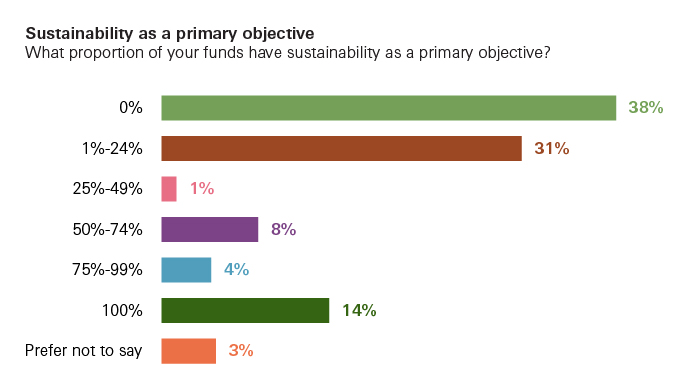
The latest results from HSBC Global Investment Research’s sustainability survey indicate that UK investors believe finance is the most material factor for driving the net zero transition, with nearly 40% seeing this as the top priority. Alongside Asia, the UK is most likely to see sustainability as a key focus with over a fifth of funds having sustainability as a primary objective.
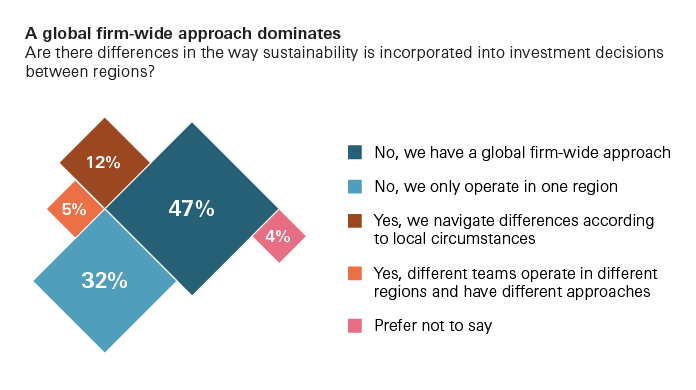
The majority of respondents incorporate sustainability into investment decisions using a global, firm-wide approach, while also taking local circumstances and markets into consideration. UK investors are no different, with nearly 60% taking a global firm-wide approach.
Support for global standards in disclosures has risen since our last survey in June 2025, even as calls for greater flexibility continue. In the UK, over 50% of investors believe there should be a standard global approach to disclosures.
Sustainability incorporation approaches highlight that integration and engagement are top among methods that investors use for incorporating sustainability decisions globally. We believe this is crucial when applying issues at all stages of the investment process. However, only 20% of UK investors utilise sustainability incorporation as their top approach for decisions, with the most commonly used method in the UK instead being sustainability scoring and ratings at 45%.
Views on regulations; disclosures are divided globally
The survey finds that 55% of UK investors stated better company disclosures as a top priority, wanting more oversight for corporates across sustainability integrity. The majority of UK investors (65%) find regulated corporate disclosures to be helpful. In contrast, global investors find regulated corporate disclosures to be of less importance to investment processes, potentially due to the regulatory burden and the call for rule simplification (and it’s worth noting that, in Europe, we observe a decrease in those finding new rules ‘not helpful’ compared to previous surveys, perhaps suggesting that stakeholders welcome recent simplifications).
Regarding voluntary initiatives on sustainability reporting, a greater share of global investors are finding them ‘not helpful’ to the investment process, notably due to developing compliance regulations. However, the majority of UK investors find the voluntary initiatives to be somewhat or very helpful to the investment process at nearly 70%.
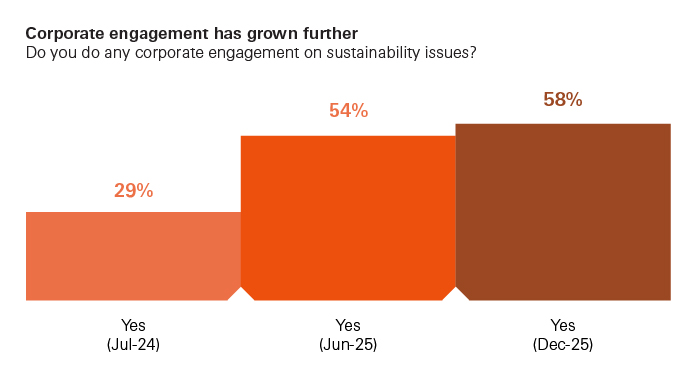
On corporate engagement, results highlight that this has increased at the top end, with more respondents executing engagement activities than previous surveys. Our survey finds that nearly 80% of UK investors engage with corporates on sustainability issues. As scrutiny over sustainability issues intensifies in the UK and regulations further develop, including the Sustainability Reporting Standards (UK-SRS), engagement is of ever-growing importance, in our view.
Sustainability funding is expected to accelerate
Over the next 12 months, the majority of global investors believe funding for the low carbon transition will accelerate or remain stable as certain economies continue to prioritise the transition and finance becomes an increasingly focused topic in climate discussions. Over 50% of UK investors believe funding for the transition will accelerate significantly or somewhat over the next 12 months, with roughly 30% stating that it will remain stable.
UK investors are looking to both government and private market investment to provide this funding, our survey suggests. Indeed, we observe growth in capacity for non‑listed securities when it comes to sustainability-related instruments, indicating success in capacity building and the interest to do so. In the UK, over 70% of investors either already have capacity or are building such to enable growth in these sustainability-related instruments.
Despite just 14% of global investors believing public market instruments will provide funding, UK investors are more hopeful with 38% stating funding for the transition will be provided by public instruments such as labelled bonds and listed equity.
Regional focal points vary
We observe clear differences on sustainability approaches when analysing regional survey results.
- UK investors believe financing the transition is key: Our survey results find that 40% of UK investors believe finance is the most material factor for driving the transition. Indeed, we observe that respondents based in the UK, alongside Asia, are the most likely to see sustainability as a primary objective and to prioritise incorporation of sustainability issues.
- Asia ranked highest on incorporating sustainability into investment decision-making as well as having more funds with sustainability as a primary objective.
- North American investors, by contrast, have deprioritised sustainability as a primary objective relative to other regions − respondents say sustainability is less incorporated and corporate engagement on sustainability issues is reducing. Respondents in this region tend to operate within one region with no global firm-wide approach to sustainability, potentially due to the diverging sustainability landscape in the region.

Source
HSBC-Survation Sustainability Sentiment Survey. The Survey was conducted by Survation from 15 October to 19 November 2025, with a sample size of 267 professionals working in the financial services industry across the globe in roles related to sustainability decision-making. Not every question was asked of every participant, as certain follow-up questions depended on the responses to previously asked questions.
Disclosure appendix
This publication has been prepared by HSBC Bank plc (“HBEU”) which is part of the HSBC Group. It is intended for information purposes only and is not intended for further distribution whether through the press or via other means. Nothing in this publication constitutes or is to be construed as an offer to buy or sell or a solicitation of an offer to buy or sell the securities or other investment products mentioned in it and/or to participate in any trading strategy. Information in this publication is general and should not be construed as investment advice or guidance as it has been prepared without taking account of the objectives, financial situation or needs of any particular investor. Investors should, accordingly, before acting on any information contained herein, consider the appropriateness of the information having regard to their objectives, financial situation and needs and should, if necessary, seek professional investment and/or tax advice.
Certain investment products mentioned in this publication may not be eligible for sale in some countries or territories and may not be suitable for all types of investors. Investors should consult with their HSBC representative regarding the suitability of any investment products mentioned taking into account their specific investment objectives, financial situation and/or particular needs before making a commitment to purchase any investment products. The value of and the income produced by investment products mentioned in this publication may fluctuate so an investor may get back less than originally invested. Certain high-volatility investments can be subject to sudden and/or large falls in value that could equal or exceed the amount invested. Value and income from investment products may be adversely affected by exchange rates, interest rates, or other factors. Past performance of a particular investment product is not indicative of future results. When an investment is denominated in a currency other than the local currency of an investor, changes in the exchange rates may have an adverse effect on the value, price or income of that investment. Where there is no recognised market for an investment, it may be difficult for an investor to sell the investment or to obtain reliable information about its value or the extent of the risk associated with it.
This publication may contain forward-looking statements which are, by their nature, subject to significant risks and uncertainties. Any such statements are projections and are used for illustration purpose only. Customers are reminded that there can be no assurance that economic conditions described herein will remain in the future. Actual results may differ materially from the forecasts and/or estimates. No assurance is given that expectations reflected in any forward-looking statements will prove to have been correct or come to fruition, and you are cautioned not to place undue reliance on such statements. No obligation is undertaken to publicly update or revise any forward-looking statements contained in this publication or in any other related publication whether as a result of new information, future events or otherwise.
This publication is distributed by HBEU, its affiliates and its associated entities (together, the “HBEU entities”) to their customers. No HBEU entity is responsible for any loss, damage or other consequence of any kind that may be incurred or suffered as a result of, arising from, or relating to any use or reliance on this publication. No HBEU entity gives any guarantee as to the accuracy, timeliness or completeness of this publication. Whether, or in what time frame, an update of any information contained herein will be published is not determined in advance. You should consult your own professional advisor if you have any questions regarding the content of this publication.
HBEU entities and their respective officers and/or employees may have interests in any products referred to in this publication by acting in various roles including as distributor, holder of principal positions, adviser or lender. HBEU entities and their respective officers and employees may receive fees, brokerage or commissions for acting in those capacities. In addition, HBEU entities and their respective officers and/ or employees may buy or sell products as principal or agent and may effect transactions which are not consistent with the information set out in this publication.
Additional disclosures
- This publication is dated as at 29 January 2026.
- All market data included in this publication is dated as at close 27 January 2026, unless a different date and/or a specific time of day is indicated in the publication.
- HBEU has procedures in place to identify and manage any potential conflicts of interest that arise in connection with its research business. HBEU’s analysts and its other staff who are involved in the preparation and dissemination of research operate and have a management reporting line independent of HBEU’s investment business. Information barrier procedures are in place between the investment banking, principal trading and research businesses to ensure that any confidential and/or price sensitive information is handled in an appropriate manner.
- Recipients of this publication are not permitted to use, for reference, any data in this publication for the purpose of (i) determining the interest payable, or other sums due, under loan agreements or under other financial contracts or instruments, (ii) determining the price at which a financial instrument may be bought, sold, traded or redeemed, or the value of a financial instrument, and/or (iii) measuring the performance of a financial instrument.
Disclaimer
In the UK, this publication is distributed by HBEU to its customers and by HSBC Bank UK plc (“HBUK”) to its customers. HBEU is registered in England and Wales (company number: 14259), registered office: 8 Canada Square, London, E14 5HQ, UK. HBUK is registered in England and Wales (company number: 09928412), registered office: 1 Centenary Square, Birmingham B1 1HQ, UK. HBEU is authorised by the Prudential Regulation Authority and regulated by the Financial Conduct Authority and the Prudential Regulation Authority (Financial Services Register number: 114216). HBUK is authorised by the Prudential Regulation Authority and regulated by the Financial Conduct Authority and the Prudential Regulation Authority (Financial Services Register number: 765112).
© Copyright 2026. HSBC Bank plc, ALL RIGHTS RESERVED. No part of this publication may be reproduced, stored in a retrieval system, or transmitted in any form or by any means, whether electronic, mechanical, photocopying, recording or otherwise, without the prior written permission of HSBC Bank plc.