

- Article
- Running a business
- General Sustainability
Exploring Climate Change Resilience at Lodge Farm
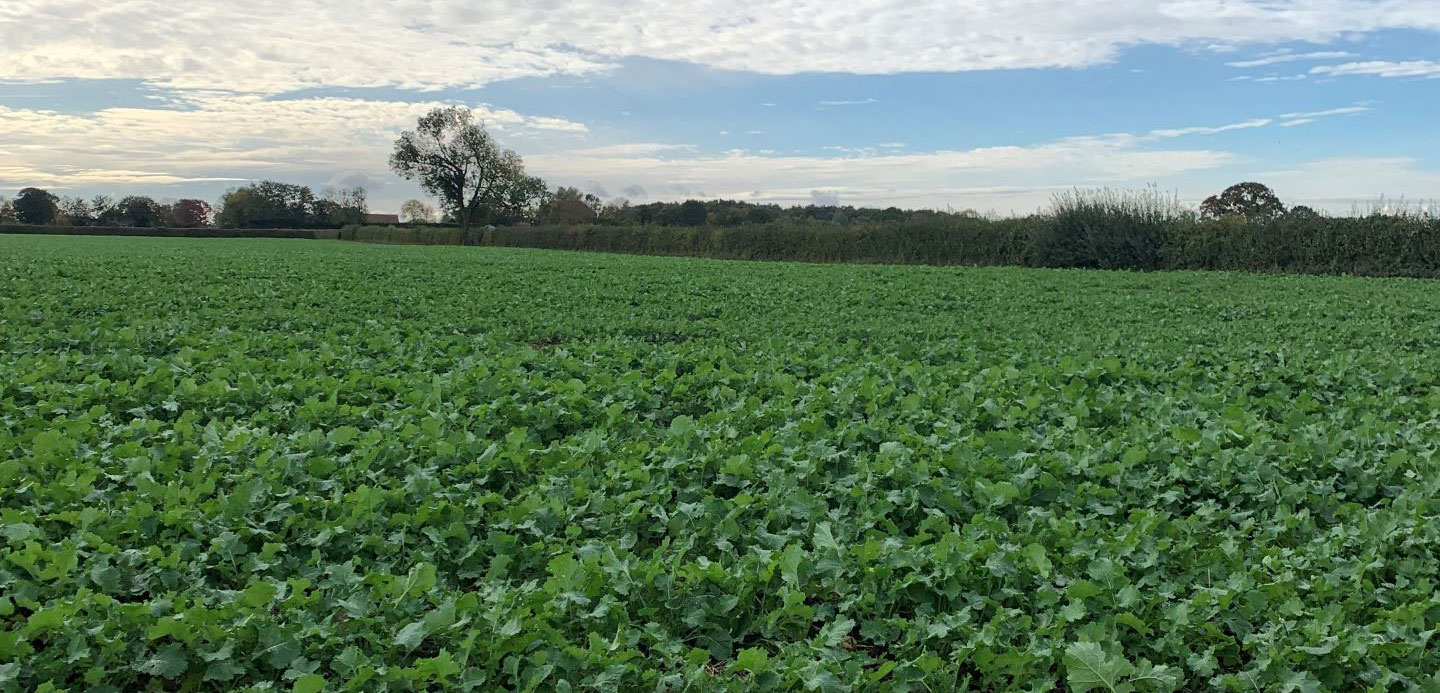
HSBC UK, in partnership with the agricultural charity LEAF, hosted a farm demonstration event at the Hawcroft’s farm in East Yorkshire, to examine the impact of climate change on the farm and what adaptation strategies are possible. Events like this help us support customers beyond day-to-day banking by bringing people together to share insights, learn from peers and explore practical ways to future proof your farm.
Farm Facts
- Arable farm
- Rotation includes wheat, barley, oilseed rape, maize and cover crops
- Harvest 2025 saw reduction in average yields due to drought
- Widespread investment in drainage across the farm allows field operations to take place even in wetter conditions
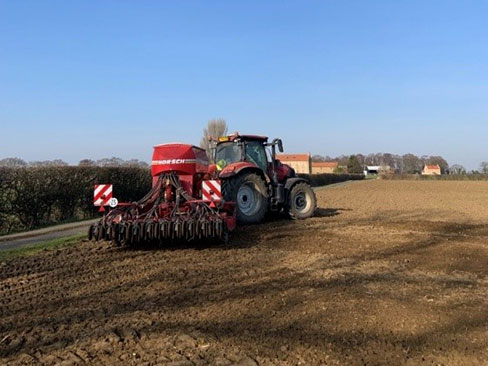
- Cultivations include low disturbance practices to preserve soil moisture
- Poultry manure used to offset artificial fertiliser
- Agri environment schemes include Countryside Stewardship Scheme (CSS) and Sustainable Farming Incentive (SFI)
- 8km of hedgerows contribute to carbon sequestration
Climate resilience event showcases options for adaptation
Gordon and Jill Hawcroft, alongside their son David run Lodge Farm in East Yorkshire, an arable farm which the family have farmed for the last 45 years. As with most arable farms, the business has been impacted by extremes of weather over the last few years and were keen to understand potential future impacts. These were explored at a demonstration event run in partnership between HSBC UK and LEAF, which brought together a range of farmers and professionals from the agricultural industry, to discuss climate change resilience, and for the Hawcrofts, to understand how they can adapt the arable business, so it remains viable for future generations.
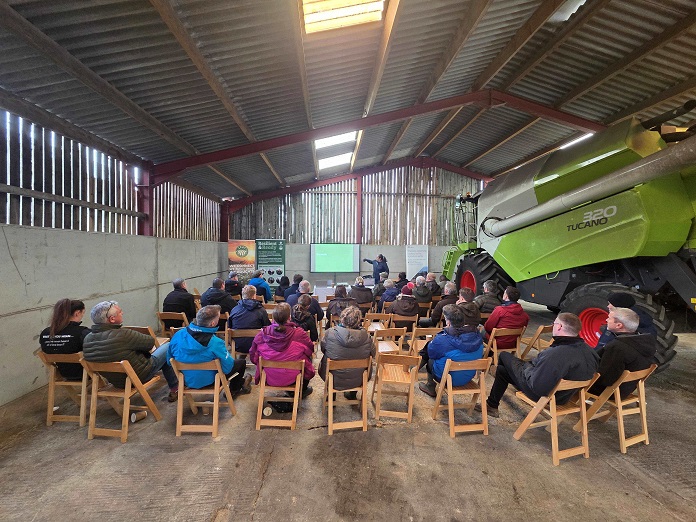
The impact on arable yields specific to the farms location was modelled by the UK Centre for Ecology and Hydrology (UKCEH), to understand yield variations through to 2080, while Farm Carbon Toolkit (FCT) undertook a carbon audit for the farm. These insights were then explored further through a farm walk at Lodge Farm in October 2025.
Climate model and mapping highlights opportunities
In a session with UKCEH, they presented detailed insights from their climate models, on potential arable yields, and what alternative crops could be grown as temperatures rise. The climate model showed that, for this farm, the potential wheat and oilseed rape yields at Lodge Farm remain above the national average through to 2080, but the challenge will come in managing the increasing variability due to extremes of weather.
To understand what adaptation measures they could take, UKCEH presented outputs from their Farm Health Check Tool. By inputting farm practice data, the tool helped reveal the opportunities at Lodge Farm. The Hawcrofts have already taken steps to manage the variation in soils they have with clay, sand and silt across the farm, however, this was an area that could be enhanced with further use of minimal cultivation techniques, incorporating crop residues and the targeted use of cover crops. Further habitat creation was also identified, to create better interconnectivity between key habitats. This could be done through targeted hedgerow planting and the use of bird seed and pollinator field margins.
Decision support software that helps link your farming data with adaptation strategies can help reassure you what you are doing is working, and know what more can be done.
FCT and Soils
Farm Carbon Toolkit then presented the results of Lodge Farm’s carbon audit, breaking down their emissions and removals. Poultry manure is already used to build organic matter, reduce artificial fertiliser use and reduce cost. Soil organic matter levels were improving, which alongside the hedgerows and woodland were supporting carbon sequestration. The farm’s carbon balance was only 22.96 tonnes CO2e, because they remove 271.88 tonnes of the 294.84 tonnes they emit.
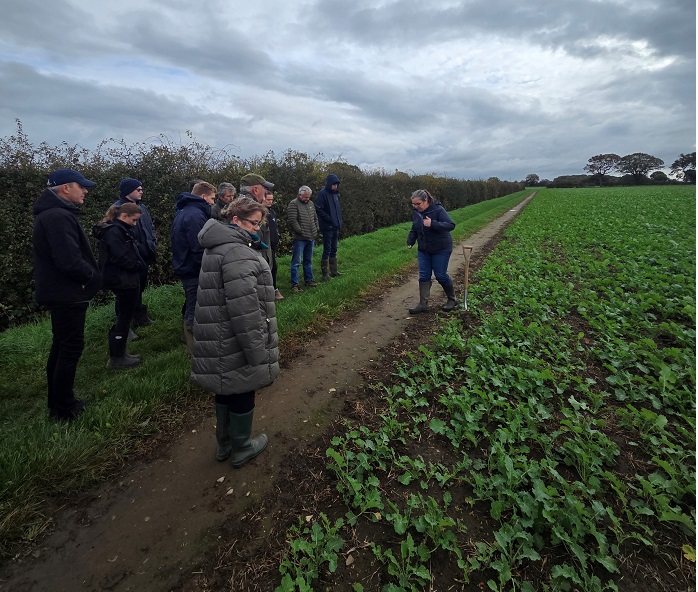
These results informed further discussions on soil health on the farm walk, where interpreting soil test results and observations of soil health such as smell, texture, root depth and worm count were covered. The event provoked discussion on what the future holds for farming in the UK, and how adapting to climate change may look different for each farmer. Importantly, it highlighted the benefit of what Gordon, and his family have already been doing, and the opportunities for them to enhance the resilience of their business.
Today we finance a number of industries that significantly contribute to greenhouse gas emissions. We have a strategy to help our customers to reduce their emissions and to reduce our own. For more information visit www.hsbc.com/sustainability.