

- 3 minutes
- Article

- Support
- Economic Reports
UK in Focus special: The summer of 2026
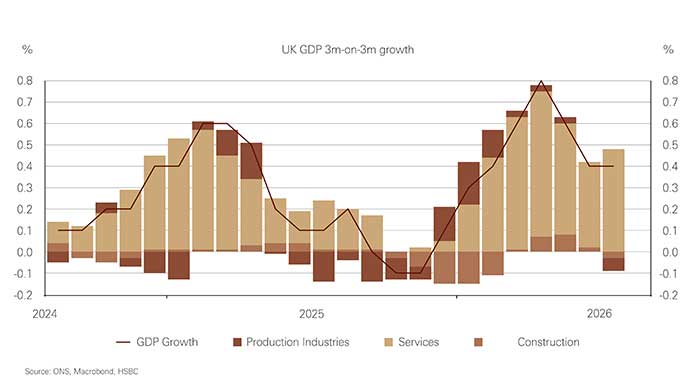
Growth improved over the summer of 2026 led by services and activity linked to artificial intelligence. Yet a softer labour market, higher energy costs and rising bond yields leave the outlook finely balanced.
Growth proves more resilient than expected
Over the summer, the UK economy quietly shifted tone. Economic growth has been resilient and in July the UK economy grew 0.4% m-o-m, despite expectations of no growth. Interestingly, the resilience in the UK economy appears to have been supported by a cluster of sectors investing into Artificial Intelligence (AI) or benefitting from greater demand for AI hardware. Admin and support services, professional services, and tech-adjacent manufacturing have all been outperformers.
A two-tiered labour market
Broader economy-wide benefits of AI are still early, but AI could worsen job-worker mismatch during the transition and potentially reinforce the “two-tier” labour market dynamic. Although the labour market has softened in recent years, younger workers, and related sectors, have been disproportionately impacted by the broad-based softness in employment growth. That means spare capacity is concentrated in a small segment of the labour force, and could mean slack and shortages of labour can coexist.
Despite weak employment, consumer confidence and spending have risen as saving has fallen. However, the summer housing market remained subdued and uneven, mainly because homes were less affordable.
A complicated inflation and rates outlook...
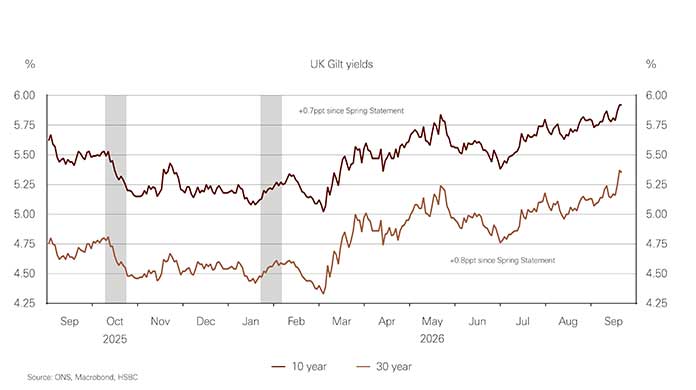
Indeed, financial conditions have tightened, bond yields have moved sharply higher over August, with the 10-year gilt yield reaching 5.37% (its highest since 2007) and markets at one point were pricing in four Bank of England (BoE) rate rises. Higher bond yields reflect global developments: an ongoing conflict in the Middle East has seen energy prices rise again (adding to upside risks to the inflation outlook), and a renewed focus on the risks of fiscal credibility given high debt levels across developed economies.
More reassuringly on inflation, higher energy prices are not, yet, translating into broader, domestic inflation pressures. A higher headline rate of inflation has been accompanied by a moderation in services inflation and private sector pay growth, the latter slowed to 2.8% (3m/yr) in July, the weakest since 2020. That will provide some comfort to BoE policymakers.
The key risk for the BoE is the longer an energy shock persists, the greater the risk it stops being “just energy” and feeds into wage demands and pricing behaviour. Against this backdrop, the November BoE policy meeting is “live” if energy stayed elevated and inflation expectations firmed.
...is making fiscal choices harder for the Government
Higher bond yields also weigh on the government’s fiscal position, adding to the challenges for the new Prime Minister and Chancellor. More broadly, the new government signalled it would stick to fiscal rules but use “any flexibility within them” pointing to the desire to borrow more to invest into the UK. While that approach can be positive if higher borrowing and investment creates additional growth, any additional borrowing will add to debt servicing costs at a time when yields are high, limiting what the government can do.
An uncertain future
Taken together, summer 2026 was about an economy that looked a bit stronger on growth, more uncertain on inflation because of energy, and structurally tricky on hiring. Looking ahead, the near-term outlook is uncertain, from interest rates, geopolitical tensions, and a UK Autumn Budget; how these develop and interact with each other will be crucial for confidence and UK growth in H2 2026.
This content and much more is available for you on the Global Investment Research and Research App (App Store | Google Play). For research questions, please email: AskResearch@hsbc.com
Important disclosures
This document is for information purposes only and it should not be regarded as an offer to sell or as a solicitation of an offer to buy the securities or other investment products mentioned in it and/or to participate in any trading strategy. Information in this document is general and should not be construed as personal advice, given it has been prepared without taking account of the objectives, financial situation or needs of any particular investor. Accordingly, investors should, before acting on it, consider the appropriateness of the information, having regard to their objectives, financial situation and needs. If necessary, seek professional investment and tax advice.
Certain investment products mentioned in this document may not be eligible for sale in some states or countries, and they may not be suitable for all types of investors. Investors should consult with their HSBC representative regarding the suitability of the investment products mentioned in this document and take into account their specific investment objectives, financial situation or particular needs before making a commitment to purchase investment products.
The value of and the income produced by the investment products mentioned in this document may fluctuate, so that an investor may get back less than originally invested. Certain high-volatility investments can be subject to sudden and large falls in value that could equal or exceed the amount invested. Value and income from investment products may be adversely affected by exchange rates, interest rates, or other factors. Past performance of a particular investment product is not indicative of future results.
HSBC and its affiliates will from time to time sell to and buy from customers the securities/instruments (including derivatives) of companies covered in HSBC Research on a principal or agency basis.
Whether, or in what time frame, an update of this analysis will be published is not determined in advance.
HSBC may use Artificial Intelligence (AI) tools approved for adoption within HSBC in the development of its research reports, utilizing these technologies to analyse large volumes of data, enhance efficiency and improve the overall user experience. This includes but is not limited to paraphrasing, developing suitable captions and supporting data visualisation. It is important to note that while AI tools assist in various aspects of report creation, all investment recommendations and opinions presented herein are formulated and approved exclusively by our research analysts. The final content of the report reflects the professional judgement and expertise of our research analysts, ensuring compliance with regulatory standards and maintaining the integrity of our research process.
- This report is dated as at 14 September 2026.
- All market data included in this report are dated as at close 11 September 2026, unless a different date and/or a specific time of day is indicated in the report.
- HSBC has procedures in place to identify and manage any potential conflicts of interest that arise in connection with its Research business. HSBC's analysts and its other staff who are involved in the preparation and dissemination of Research operate and have a management reporting line independent of HSBC's Investment Banking business. Information Barrier procedures are in place between the Investment Banking, Principal Trading, and Research businesses to ensure that any confidential and/or price sensitive information is handled in an appropriate manner.
- You are not permitted to use, for reference, any data in this document for the purpose of (i) determining the interest payable, or other sums due, under loan agreements or under other financial contracts or instruments, (ii) determining the price at which a financial instrument may be bought or sold or traded or redeemed, or the value of a financial instrument, and/or (iii) measuring the performance of a financial instrument or of an investment fund