- Article

- Support
- Economic Reports
- Market Research
UK in Focus: Essential UK economic news for businesses
UK economic activity has been resilient despite a challenging backdrop. Confidence has improved alongside business investment, but households are more cautious. Meanwhile, prolonged inflationary pressure could drive rate hikes, while the economy braces for another uncertain Budget.
A resilient economy in the face of uncertainty
UK growth has proved more resilient – the economy grew 0.5% q-o-q in Q2, following a 0.6% rise in the first quarter. That momentum seems to have continued over the summer, albeit at a slower pace with surveys of both the services and manufacturing sectors citing more modest activity gains over the quarter. Nonetheless, with a robust 0.4% m-o-m growth rate in July alone, we expect the UK economy to post a third consecutive quarter of growth at or above half a percentage point.
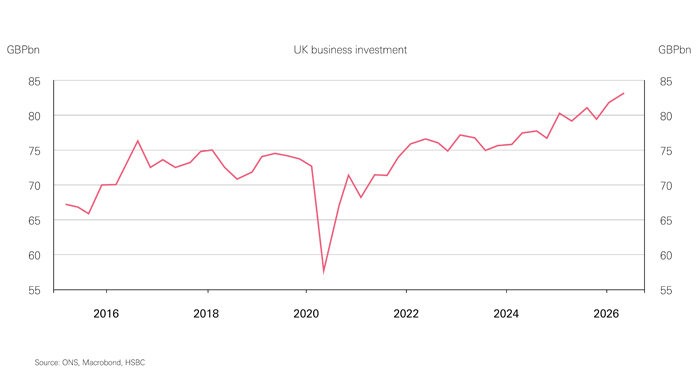
Underlying growth dynamics have also improved, despite significant uncertainty so far in 2026. Business investment has grown 5.2% y-o-y, the majority of which is centred around AI investment, most notably within the professional services sector. Manufacturers have also cited an uptick in demand from AI-related manufacturing. AI adoption is still in its infancy and yet to broaden out meaningfully across the economy – 45% firms that use AI use free-to-use platforms, and hence, investment in the technology should continue and provide a demand impulse to growth. That being said, the speed at which the investment translates into productive capacity may be modest, with global AI supply constraints and prices ratcheting higher.
Households move from squeezed to cautious…
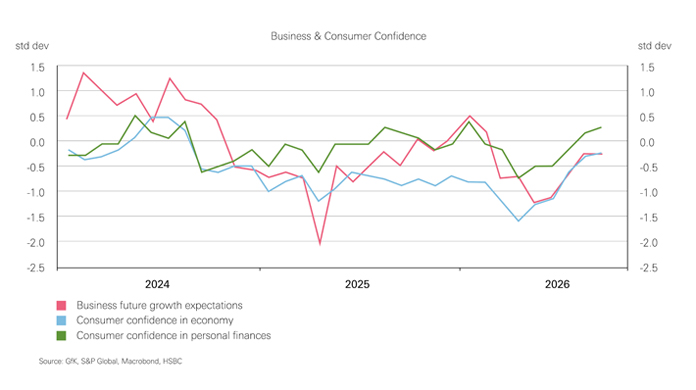
Elsewhere, households saw real household disposable income per head rise 1.0% q-o-q in Q2, reversing the 0.8% fall in Q1. Meanwhile, retail sales volumes increased 0.9% in the three months to August − 2.4% higher than a year earlier − and confidence improved for a third consecutive month to a two-year high.
However, at the same time, the household sector has continued to show signs of caution – the household saving ratio rose from 8.6% to 8.8% in Q2, perhaps driven by precautionary saving. Meanwhile, direct debit defaults have continued to tick higher and credit card usage has risen strongly, which may be more indicative of budget stress. Overall, despite a broad-based improvement in activity and sentiment, households continue to show pockets of stress as they still adjust to the prior inflationary period. As such, consumers enter the latest shock in different starting positions and with exposures to energy costs and interest rates. A continued recovery in consumer sentiment will be more difficult over the near term.
Ultimately, the Monetary Policy Committee (MPC) is keenly watching for evidence that the energy shock translates into greater domestically driven inflation, primarily via higher wages. In our view, given the projected path of inflation, and with inflation and wage expectations on the edge of tolerable levels, the MPC will opt to hike rates before wage inflation materialises. We pencil in a 25bp hike before the end of 2026 and a second hike in February 2027, before cuts resume in H2 2027.
Autumn Budget season set to be crisp and uncomfortable
Higher interest rates and inflation concerns have pushed yields on government debt higher across the world, alongside concerns over issuance and fiscal sustainability risks. That sees 10-year rates around 75bp higher than the OBR’s forecasts in March 2026 that were set prior to the conflict. Indeed, higher debt servicing costs so far in the current fiscal year have pushed public sector net borrowing cGBP8.0bn higher than OBR expectations.
In effect, the economic backdrop contributes to an erosion of the headroom against the government’s fiscal target to have the current budget balanced by 2029/30. So, again, the UK finds itself in a position of policy uncertainty in the lead up to the Autumn Budget, 28 October 2026. The government has also raised the prospect of giving households and businesses ‘breathing space’ but with little to suggest public spending cuts are on the table, it will fall to higher taxes and borrowing to rebuild headroom and fund some ‘give-aways’. On that basis, small, temporary, and targeted relief seems most likely.
This content and much more is available for you on the Global Investment Research and Research App ( App Store | Google Play ). For research questions, please email: AskResearch@hsbc.com
Download a PDF version of the report
Analyst Certification
The following analyst(s), economist(s), or strategist(s) who is(are) primarily responsible for this report, including any analyst(s) whose name(s) appear(s) as author of an individual section or sections of the report and any analyst(s) named as the covering analyst(s) of a subsidiary company in a sum-of-the-parts valuation certifies(y) that the opinion(s) on the subject security(ies) or issuer(s), any views or forecasts expressed in the section(s) of which such individual(s) is(are) named as author(s), and any other views or forecasts expressed herein, including any views expressed on the back page of the research report, accurately reflect
their personal view(s) and that no part of their compensation was, is or will be directly or indirectly related to the specific recommendation(s) or views contained in this research report: Emma Wilks.
Important disclosures
This document has been prepared and is being distributed by the Research Department of HSBC and is intended solely for the clients of HSBC and is not for publication to other persons, whether through the press or by other means.
This document is for information purposes only and it should not be regarded as an offer to sell or as a solicitation of an offer to buy the securities or other investment products mentioned in it and/or to participate in any trading strategy. Advice in this document is general and should not be construed as personal advice, given it has been prepared without taking account of the objectives, financial situation or needs of any particular investor. Accordingly, investors should, before acting on the advice, consider the appropriateness of the advice, having regard to their objectives, financial situation and needs. If necessary, seek professional investment and tax advice.
Certain investment products mentioned in this document may not be eligible for sale in some states or countries, and they may not be suitable for all types of investors. Investors should consult with their HSBC representative regarding the suitability of the investment products mentioned in this document and take into account their specific investment objectives, financial situation or particular needs before making a commitment to purchase investment products.
The value of and the income produced by the investment products mentioned in this document may fluctuate, so that an investor may get back less than originally invested. Certain high-volatility investments can be subject to sudden and large falls in value that could equal or exceed the amount invested. Value and income from investment products may be adversely affected by exchange rates, interest rates, or other factors. Past performance of a particular investment product is not indicative of future results.
HSBC and its affiliates will from time to time sell to and buy from customers the securities/instruments, both equity and debt (including derivatives) of companies covered in HSBC Research on a principal or agency basis or act as a market maker or liquidity provider in the securities/instruments mentioned in this report.
Analysts, economists, and strategists are paid in part by reference to the profitability of HSBC which includes investment banking, sales & trading, and principal trading revenues.
Whether, or in what time frame, an update of this analysis will be published is not determined in advance.
For disclosures in respect of any company mentioned in this report, please see the most recently published report on that company
available at www.hsbcnet.com/research. HSBC Private Bank clients should contact their Relationship Manager for queries regarding other research reports. In order to find out more about the proprietary models used to produce this report, please contact the authoring analyst.
HSBC may use Artificial Intelligence (AI) tools approved for adoption within HSBC in the development of its research reports, utilizing these technologies to analyse large volumes of data, enhance efficiency and improve the overall user experience. This includes but is not limited to paraphrasing, developing suitable captions and supporting data visualisation. It is important to note that while AI tools assist in various aspects of report creation, all investment recommendations and opinions presented herein are formulated and approved exclusively by our research analysts. The final content of the report reflects the professional judgement and expertise of our research analysts, ensuring compliance with regulatory standards and maintaining the integrity of our research process.
- This report is dated as at 02 October 2026.
- All market data included in this report are dated as at close 01 October 2026, unless a different date and/or a specific time of day is indicated in the report.
- HSBC has procedures in place to identify and manage any potential conflicts of interest that arise in connection with its Research business. HSBC's analysts and its other staff who are involved in the preparation and dissemination of Research operate and have a management reporting line independent of HSBC's Investment Banking business. Information Barrier procedures are in place between the Investment Banking, Principal Trading, and Research businesses to ensure that any confidential and/or price sensitive information is handled in an appropriate manner.
- You are not permitted to use, for reference, any data in this document for the purpose of (i) determining the interest payable, or other sums due, under loan agreements or under other financial contracts or instruments, (ii) determining the price at which a financial instrument may be bought or sold or traded or redeemed, or the value of a financial instrument, and/or (iii) measuring the performance of a financial instrument or of an investment fund