

- Article

- Support
- Economic Reports
- Market Research
UK in Focus: Essential UK economic news for businesses
The UK economy has continued to grow at pace, although there are signs of a two-speed economy. Energy prices continue to drive inflation higher, squeezing household budgets, and the BoE also sees some domestic inflationary pressures which could drive another hike in interest rates.
Still standing…
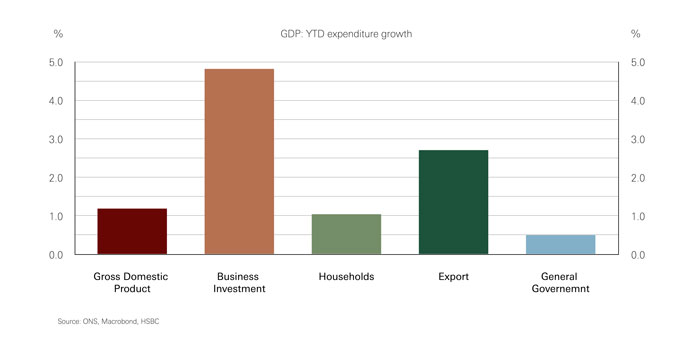
The UK economy has continued to defy expectations. GDP rose 0.1% m-o-m in August, taking three-month growth to 0.7%, supported by manufacturing and professional services. More timely surveys suggest that momentum continued into the autumn with October’s composite PMI reaching an eight-month high of 52.9, driven by stronger activity across both manufacturing and services.
The labour market has continued to stabilise. The unemployment rate fell from 4.9% to 4.7% in the three months to August, while payroll employment rose by 13k in September and services firms reported their first increase in headcount in over two years.
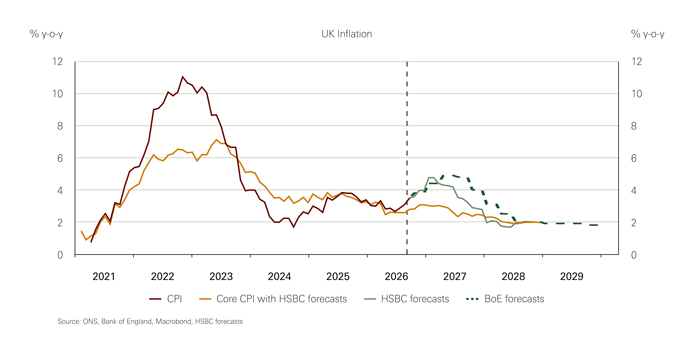
Higher energy prices are pushing up the rate of inflation – CPI inflation rose from 3.1% to 3.5% y-o-y in September – squeezing household budgets. However, outside of the energy shock, price growth has been more contained. Core inflation, which excludes food and energy, increased to 2.8% y-o-y, while services inflation was 3.6% y-o-y in September and food and drink inflation was subdued at 1.3%.
…but not everyone is feeling it…
The headline resilience masks a two-speed economy. Business-to-business services and AI-related investment are providing support, while manufacturers have cited an uptick in AI-related demand. That contrasts with the weakness seen across consumer-facing services and construction.
On the former, households have cushioned spending growth by saving less, but that cannot continue indefinitely and the winter energy price squeeze is yet to bite. We expect inflation to rise further and to peak in January 2027, and for the rate of inflation to remain elevated throughout next year.
Moreover, the more prolonged the energy shock is, the higher the risk of price passthrough along supply chains. A survey from the BoE in October suggested that in response to higher energy costs, 68% of firms intend to raise prices, while 71% expect lower profit margins. More recently, energy prices have fallen, although they remain well above their levels at the start of the year and are volatile given the lack of clear resolution to the Iran conflict.
…and winter chills are coming
We therefore expect modest consumption growth over the coming months, with more energy and interest-rate-exposed households bearing the brunt. Indeed, consumer data has softened, retail sales volume growth slowed to 0.8% y-o-y in September, despite stronger fuel sales, and consumer confidence dropped sharply in October to -24, almost entirely reversing its improvement since April. A difficult housing market, often cited as a bellwether for UK confidence, will not be helping. Higher mortgage rates have more than offset income growth in recent years, leaving repayment-based borrowing capacity strained relative to house prices and stagnant sales growth.
The Bank of England gets ahead of the inflation spike…
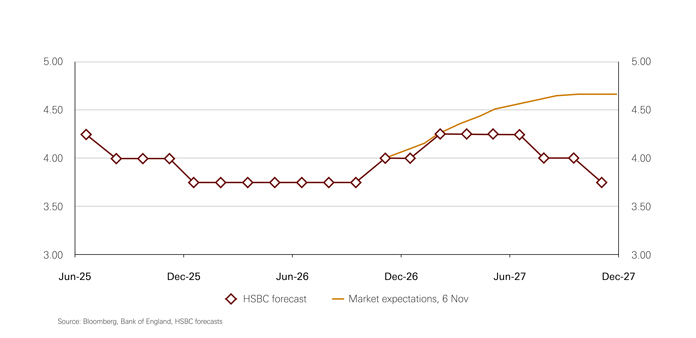
The combination of stronger activity, a more stable employment backdrop and higher energy costs prompted the BoE to raise Bank Rate on 5 November, from 3.75% to 4.00%. The vote for a higher interest rate was unanimous, although one member of the committee, Catherine Mann, preferred a larger 50bp rise. Regardless, all members backed the hike against the risk that energy inflation would feed into wider price and wage-setting.
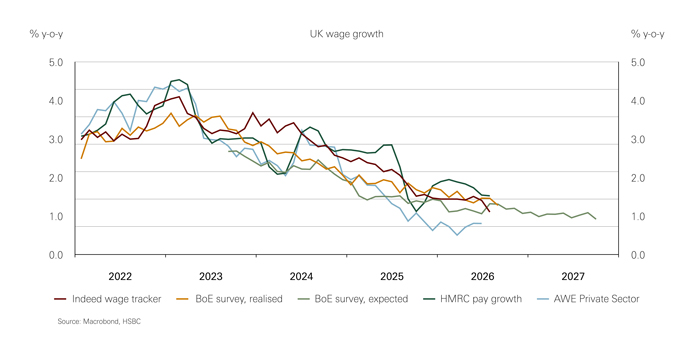
The Bank of England raised its expectation of the degree to which the energy shocks will translate into domestically driven price pressures. The Bank’s updated inflation profile saw a 4.9% peak CPI rate in Q2 2027 and at 4.0% at year end. It also raised its wage growth forecast from 3.1% to 3.5% in 2027 and to 3.4% in 2028 – marginally higher than the rate of wage growth the BoE judges to be consistent with 2% medium-term inflation.
For now, pay growth data is mixed, while official private-sector regular pay growth was 3.0% on a three-month annual basis in August, whole-economy regular pay growth rose to 3.7% and some survey measures point to pay growth closer to 4.0%. We maintain the view that the labour market is weak enough to prevent a material reacceleration in pay growth. However, the NLW is set to rise 3.9% in April 2027, there are still signs of a two-tiered labour market, and the BoE noted that, in its view, domestic price “pressures remain somewhat elevated” (BoE Monetary Policy Report, 5 November 2026).
We continue to expect one further 25bp hike in February, taking Bank Rate to 4.25%, rather than a prolonged hiking cycle. But the increase could come sooner, at the 17 December meeting, particularly if recent falls in energy prices reverse or pay settlements prove stronger.
…despite the ‘breathing space’ measures announced in the Autumn Budget
Chancellor John Healey’s first Budget delivered its promised lack of drama. Fiscal headroom was restored to GBP14.5bn, while a council tax rebate, changes to gas bills and an extended fuel duty freeze offered temporary breathing space. Although measures announced were not enough to change the inflation or growth outlooks.
Moreover, the medium- and long-term fiscal picture remains challenging. The Autumn Budget plans incorporate more spending, more taxation and GBP65bn of additional borrowing over five years relative to its March forecasts. Some greater investment in housing, energy and defence could support growth, but the OBR did not judge it to do so meaningfully over the coming three years. Meanwhile, plans to constrain departmental budgets and wider policy ambitions leave substantial funding questions for next year’s Spending Review.
This content and much more is available for you on the Global Investment Research [https://www.research.hsbc.com/] and Research App (App Store | Google Play). For research questions, please email: AskResearch@hsbc.com
Download a PDF version of the report
Analyst Certification
The following analyst(s), economist(s), or strategist(s) who is(are) primarily responsible for this report, including any analyst(s) whose name(s) appear(s) as author of an individual section or sections of the report and any analyst(s) named as the covering analyst(s) of a subsidiary company in a sum-of-the-parts valuation certifies(y) that the opinion(s) on the subject security(ies) or issuer(s), any views or forecasts expressed in the section(s) of which such individual(s) is(are) named as author(s), and any other views or forecasts expressed herein, including any views expressed on the back page of the research report, accurately reflect
their personal view(s) and that no part of their compensation was, is or will be directly or indirectly related to the specific recommendation(s) or views contained in this research report: Emma Wilks.
Important disclosures
This document has been prepared and is being distributed by the Research Department of HSBC and is intended solely for the clients of HSBC and is not for publication to other persons, whether through the press or by other means.
This document is for information purposes only and it should not be regarded as an offer to sell or as a solicitation of an offer to buy the securities or other investment products mentioned in it and/or to participate in any trading strategy. Advice in this document is general and should not be construed as personal advice, given it has been prepared without taking account of the objectives, financial situation or needs of any particular investor. Accordingly, investors should, before acting on the advice, consider the appropriateness of the advice, having regard to their objectives, financial situation and needs. If necessary, seek professional investment and tax advice.
Certain investment products mentioned in this document may not be eligible for sale in some states or countries, and they may not be suitable for all types of investors. Investors should consult with their HSBC representative regarding the suitability of the investment products mentioned in this document and take into account their specific investment objectives, financial situation or particular needs before making a commitment to purchase investment products.
The value of and the income produced by the investment products mentioned in this document may fluctuate, so that an investor may get back less than originally invested. Certain high-volatility investments can be subject to sudden and large falls in value that could equal or exceed the amount invested. Value and income from investment products may be adversely affected by exchange rates, interest rates, or other factors. Past performance of a particular investment product is not indicative of future results.
HSBC and its affiliates will from time to time sell to and buy from customers the securities/instruments, both equity and debt (including derivatives) of companies covered in HSBC Research on a principal or agency basis or act as a market maker or liquidity provider in the securities/instruments mentioned in this report.
Analysts, economists, and strategists are paid in part by reference to the profitability of HSBC which includes investment banking, sales & trading, and principal trading revenues.
Whether, or in what time frame, an update of this analysis will be published is not determined in advance.
For disclosures in respect of any company mentioned in this report, please see the most recently published report on that company
available at www.hsbcnet.com/research. HSBC Private Bank clients should contact their Relationship Manager for queries regarding other research reports. In order to find out more about the proprietary models used to produce this report, please contact the authoring analyst.
HSBC may use Artificial Intelligence (AI) tools approved for adoption within HSBC in the development of its research reports, utilizing these technologies to analyse large volumes of data, enhance efficiency and improve the overall user experience. This includes but is not limited to paraphrasing, developing suitable captions and supporting data visualisation. It is important to note that while AI tools assist in various aspects of report creation, all investment recommendations and opinions presented herein are formulated and approved exclusively by our research analysts. The final content of the report reflects the professional judgement and expertise of our research analysts, ensuring compliance with regulatory standards and maintaining the integrity of our research process.
- This report is dated as at 09 November 2026.
- All market data included in this report are dated as at close 06 November 2026, unless a different date and/or a specific time of day is indicated in the report.
- HSBC has procedures in place to identify and manage any potential conflicts of interest that arise in connection with its Research business. HSBC's analysts and its other staff who are involved in the preparation and dissemination of Research operate and have a management reporting line independent of HSBC's Investment Banking business. Information Barrier procedures are in place between the Investment Banking, Principal Trading, and Research businesses to ensure that any confidential and/or price sensitive information is handled in an appropriate manner.
- You are not permitted to use, for reference, any data in this document for the purpose of (i) determining the interest payable, or other sums due, under loan agreements or under other financial contracts or instruments, (ii) determining the price at which a financial instrument may be bought or sold or traded or redeemed, or the value of a financial instrument, and/or (iii) measuring the performance of a financial instrument or of an investment fund