

- 3 minutes
- Article

- Support
- Economic Reports
- Market Research
UK in Focus: Essential economic news for businesses
There have been some signs of resilience heading into the latest shock but sentiment has tumbled as price pressures intensify. The BoE is focused on the risk that this latest bout of inflation becomes embedded in wages.
Some demand resilience, but price pressures intensify
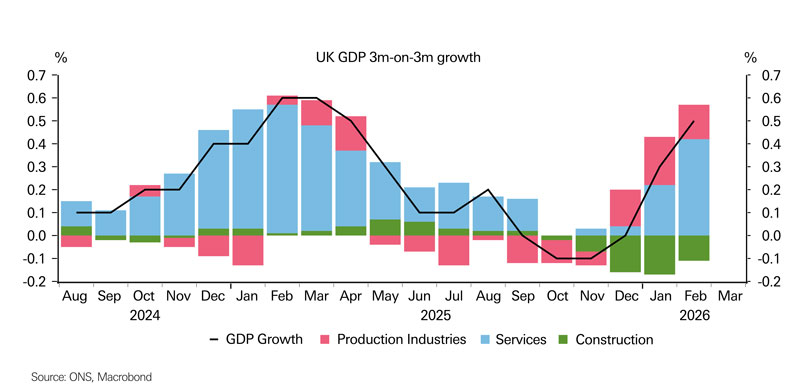
The UK economy reported the fastest pace of growth since April 2025 in the three months to February. That means the UK had a firm base heading into the latest period of uncertainty. In fact, activity surveys in April continued to report a degree of demand momentum. The manufacturing sector PMI jumped to 53.7, bolstered by new order growth, while the services sector reported higher business activity with a PMI of 52.0. However, reports of inventory accumulation ahead of expected supply disruption likely overstate activity momentum. Retail sales demand was also flattered by a degree of panic buying of motor fuel, +3.2% m-o-m in March, while overall, retail sales volumes excluding fuel grew a meagre 0.2% m-o-m.
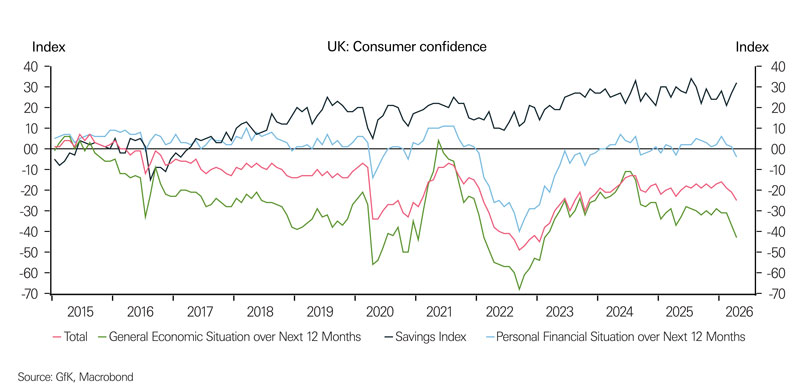
Elsewhere, consumer confidence fell further in April, taking sentiment to its lowest level in over two years. It’s no surprise that facing another inflation shock has left consumers particularly cautious about the future state of the economy, and their own personal financial situations, for the latter, the net balance fell back negative. Savings intentions also rose, new-buyer enquiries for home purchases fell to their lowest level since August 2023 in March, and medium-term inflation expectations have spiked higher.
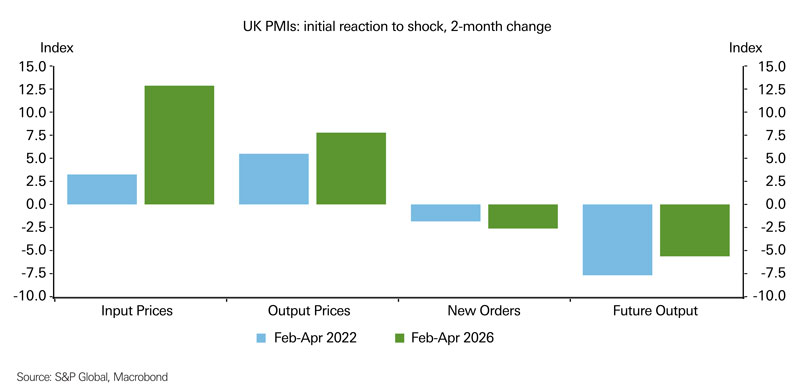
While the initial volatility across both household and business surveys may subside in the coming months, energy prices and supply disruption will continue to pass through the global economy for a while yet. And early indicators suggest agents have a greater sensitivity to price rises with a degree of pass-through evident despite the prospect of softer demand – see chart.
For the Bank of England, the extent to which the latest price shock translates into domestically driven inflation will determine the policy response. In our view, the risk of any second-round inflationary effects is smaller than in recent years, and at its latest policy meeting, the BoE seemed to agree. Nonetheless, the BoE’s scenarios showed how different assumptions on second-round effects, namely through higher wage growth, would require greater interest rate hikes. Such effects can take well over a year to materialise, but if the central bank were to wait for that, it may need to respond more aggressively than otherwise needed; therefore, hikes sooner to mitigate the risk are more likely.
For now, market expectations of rate hikes have tightened financial conditions, meaning the BoE may opt to wait and see in the hope of greater clarity on the conflict, and to see how households and businesses respond.
With that said, unless there is a swift resolution to the conflict and a reopening of the Strait of Hormuz, we expect the BoE to need to raise Bank Rate in the summer. The rate of inflation is set to accelerate, and with households and businesses more sensitive to higher prices, we think policymakers are likely to opt to lean against the risk that higher inflation now becomes embedded within household and business price expectations.
This content and much more is available for you on the Global Investment Research and Research App (App Store | Google Play). For research questions, please email: AskResearch@hsbc.com
Download a PDF version of the report
Analyst Certification
The following analyst(s), economist(s), or strategist(s) who is(are) primarily responsible for this report, including any analyst(s) whose name(s) appear(s) as author of an individual section or sections of the report and any analyst(s) named as the covering analyst(s) of a subsidiary company in a sum-of-the-parts valuation certifies(y) that the opinion(s) on the subject security(ies) or issuer(s), any views or forecasts expressed in the section(s) of which such individual(s)is(are) named as author(s), and any other views or forecasts expressed herein, including any views expressed on the back page of the research report, accurately reflect their personal view(s) and that no part of their compensation was, is or will be directly or indirectly related to the specific recommendation(s) or views contained in this research report: Emma Wilks.
Important disclosures
This document has been prepared and is being distributed by the Research Department of HSBC and is intended solely for the clients of HSBC and is not for publication to other persons, whether through the press or by other means.
This document is for information purposes only and it should not be regarded as an offer to sell or as a solicitation of an offer to buy the securities or other investment products mentioned in it and/or to participate in any trading strategy. Advice in this document is general and should not be construed as personal advice, given it has been prepared without taking account of the objectives, financial situation or needs of any particular investor. Accordingly, investors should, before acting on the advice, consider the appropriateness of the advice, having regard to their objectives, financial situation and needs. If necessary, seek professional investment and tax advice.
Certain investment products mentioned in this document may not be eligible for sale in some states or countries, and they may not be suitable for all types of investors. Investors should consult with their HSBC representative regarding the suitability of the investment products mentioned in this document and take into account their specific investment objectives, financial situation or particular needs before making a commitment to purchase investment products.
The value of and the income produced by the investment products mentioned in this document may fluctuate, so that an investor may get back less than originally invested. Certain high-volatility investments can be subject to sudden and large falls in value that could equal or exceed the amount invested. Value and income from investment products may be adversely affected by exchange rates, interest rates, or other factors. Past performance of a particular investment product is not indicative of future results.
HSBC and its affiliates will from time to time sell to and buy from customers the securities/instruments, both equity and debt (including derivatives) of companies covered in HSBC Research on a principal or agency basis or act as a market maker or liquidity provider in the securities/instruments mentioned in this report.
Analysts, economists, and strategists are paid in part by reference to the profitability of HSBC which includes investment banking, sales & trading, and principal trading revenues.
Whether, or in what time frame, an update of this analysis will be published is not determined in advance.
For disclosures in respect of any company mentioned in this report, please see the most recently published report on that company available at www.hsbcnet.com/research. HSBC Private Bank clients should contact their Relationship Manager for queries regarding other research reports. In order to find out more about the proprietary models used to produce this report, please contact the authoring analyst.
- This report is dated as at 12 May 2026.
- All market data included in this report are dated as at close 11 May 2026, unless a different date and/or a specific time of day is indicated in the report.
- HSBC has procedures in place to identify and manage any potential conflicts of interest that arise in connection with its Research business. HSBC's analysts and its other staff who are involved in the preparation and dissemination of Research operate and have a management reporting line independent of HSBC's Investment Banking business. Information Barrier procedures are in place between the Investment Banking, Principal Trading, and Research businesses to ensure that any confidential and/or price sensitive information is handled in an appropriate manner.
- You are not permitted to use, for reference, any data in this document for the purpose of (i) determining the interest payable, or other sums due, under loan agreements or under other financial contracts or instruments, (ii) determining the price at which a financial instrument may be bought or sold or traded or redeemed, or the value of a financial instrument, and/or (iii) measuring the performance of a financial instrument or of an investment fund.