

- 3 minutes
- Article

- Support
- Economic Reports
- Market Research
UK in Focus: Essential economic news for businesses
Headline indicators evidence the UK’s relatively benign position before the latest energy supply shock but business surveys point to weaker demand and greater price pressures. This combination could leave the BoE on the sidelines, waiting for more clarity before deciding on any policy change.
Sector divergence across activity indicators
On the face of it, the official data over the past month has been encouraging. Growth came in stronger than expected in Q1, the rate of inflation slowed to 2.8% y-o-y in April, and labour market conditions were soft – soft enough such that the risk of persistent inflation was subsiding but not weak enough to be of major concern to activity. However, those indicators are inherently backward looking, and other than higher petrol prices putting now upward pressure on inflation, largely reflect economic conditions before the conflict in the Middle East.
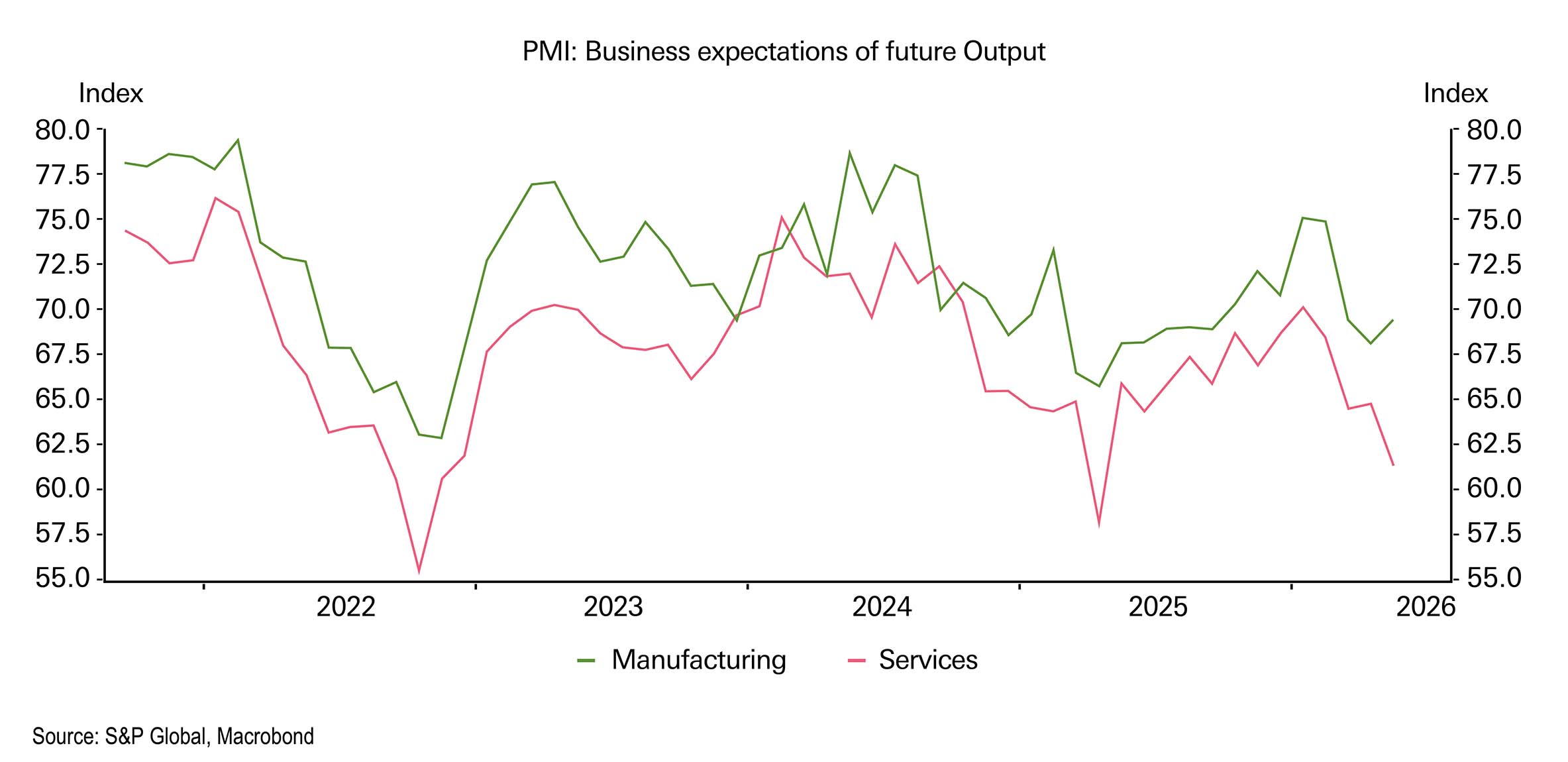
Timelier business surveys paint a less reassuring picture. The PMI survey in May showed a loss of activity momentum and confidence in future output, driven by a subdued services sector. Within the sector, concerns are broad based, from higher energy costs, business rates, inflation and falling demand, with the pressures most acute in hospitality. The manufacturing sector, meanwhile, was more resilient, with the output index rising to its highest since October 2024. However, that perceived momentum is likely to be short lived given that both the proportion of manufacturers accumulating inventory, and those reporting global supply chain disruption, have doubled, according to an ONS business survey.
For consumers, while official pay data may overstate the current decline in real incomes (-0.5% 3m/3m). Other pay indicators point to more robust pay growth but, in any case, a likely rise in inflation over the summer will drag on household purchasing power. Moreover, subdued confidence and heightened uncertainty may leave consumers sat on the sidelines, with both the housing market and leisure travel having already seen a drop in demand.
Price pressures and policy choices
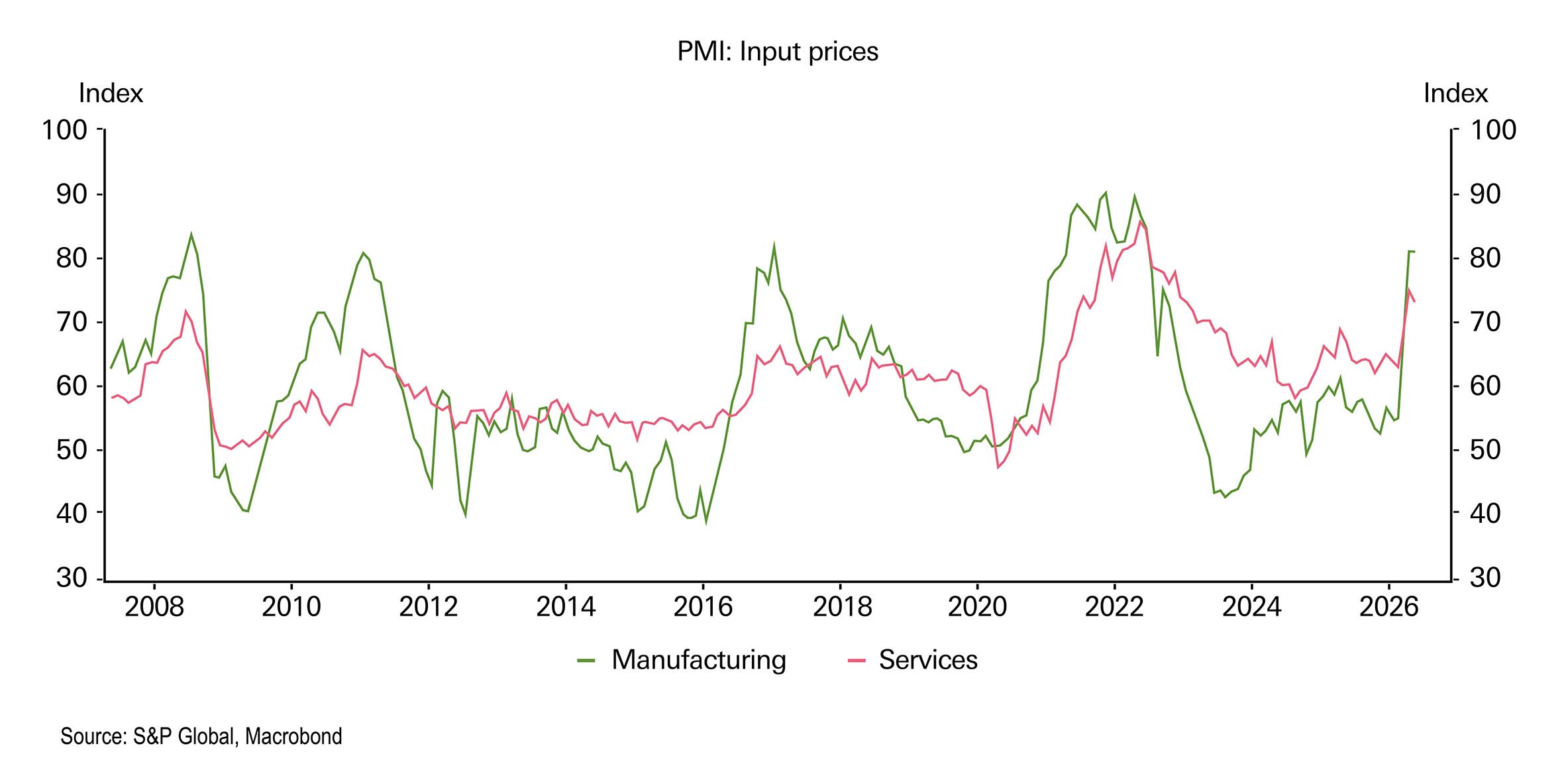
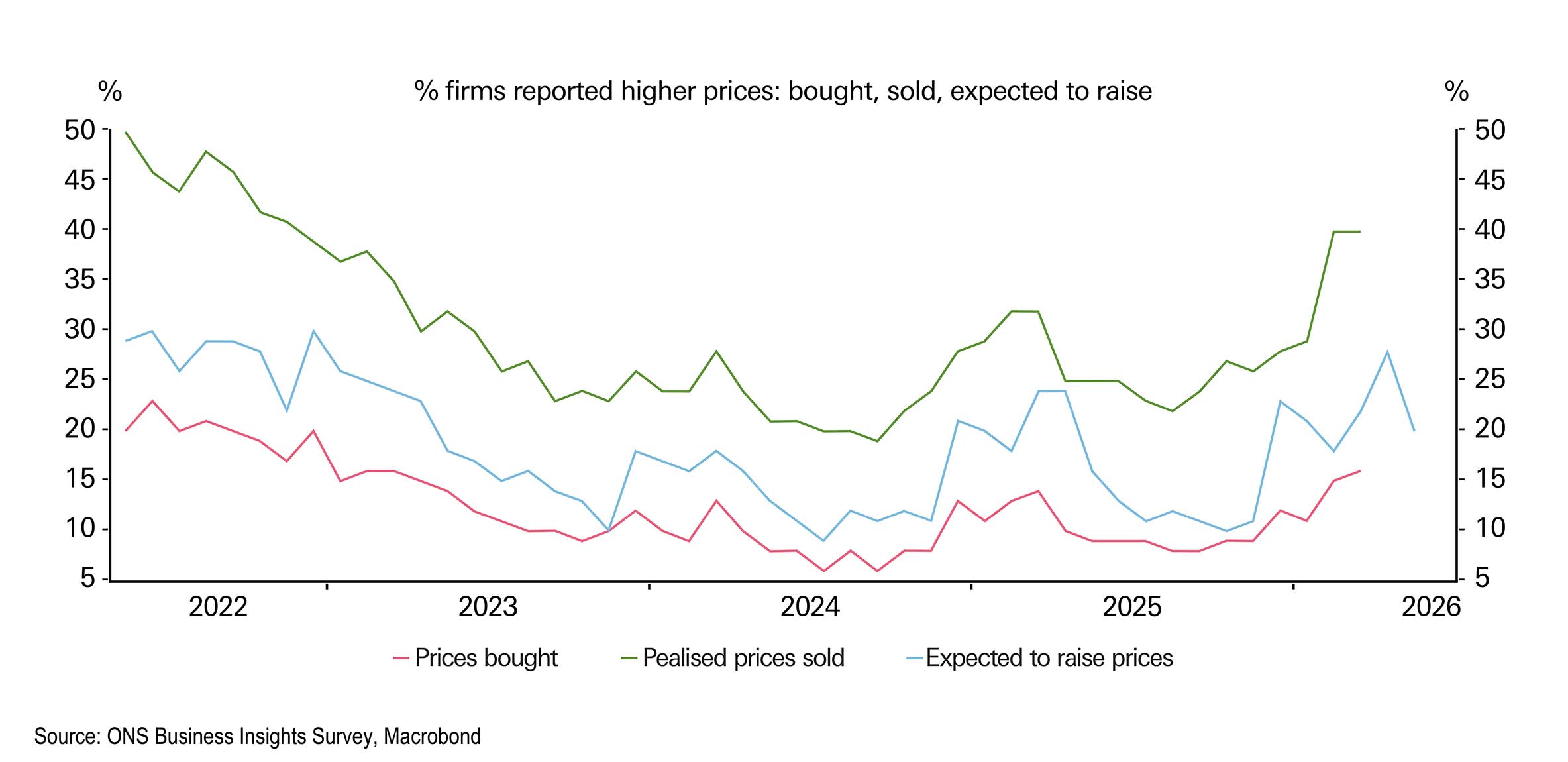
Alongside the troubling demand backdrop, price pressures have intensified to levels comparable to previous global price shocks (chart 2). Forty percent of firms reported a rise in the cost of inputs in April, according to an ONS survey, with 20% of firms expected to raise prices in June. Higher energy and raw material prices are compounding elevated labour costs, and with further supply disruption possible, those pressures may persist over the second half of 2026. However, realised price increases have often undershot expectations (chart 3), a possible reflection of an inability to fully pass costs on when pressures are sector agnostic and demand is weak.
For the Bank of England (BoE), the current growth-inflation mix in the data supports the premise that there is not a compelling case to rush to raise interest rate. Growth is soft, and despite price pressures in the pipeline, prospective pass through to consumer prices is uncertain. Indeed, BoE Governor Andrew Bailey recently noted the trade-off that higher interest rates have on ensuring inflation falls back to 2% in the medium term, and output growth. And as such, financial markets are not entirely convinced that we will see a rate hike this side of the summer. However, the pipeline of price pressures is evident. We expect inflation to accelerate to c4%, and the risk of second-round effects from both the pass-through of higher production costs and higher wage demands will keep the BoE on high alert for some time.
For now, though, with the policy rate still in restrictive territory and already tighter financial conditions, policymakers may prefer to wait and see, in the hope for greater clarity on the conflict, and to see how households and business will respond.
This content and much more is available for you on the Global Investment Research and Research App (App Store | Google Play). For research questions, please email: AskResearch@hsbc.com
Download a PDF version of the report
Analyst Certification
The following analyst(s), economist(s), or strategist(s) who is(are) primarily responsible for this report, including any analyst(s) whose name(s) appear(s) as author of an individual section or sections of the report and any analyst(s) named as the covering analyst(s) of a subsidiary company in a sum-of-the-parts valuation certifies(y) that the opinion(s) on the subject security(ies) or issuer(s), any views or forecasts expressed in the section(s) of which such individual(s)is(are) named as author(s), and any other views or forecasts expressed herein, including any views expressed on the back page of the research report, accurately reflect their personal view(s) and that no part of their compensation was, is or will be directly or indirectly related to the specific recommendation(s) or views contained in this research report: Emma Wilks.
Important disclosures
This document has been prepared and is being distributed by the Research Department of HSBC and is intended solely for the clients of HSBC and is not for publication to other persons, whether through the press or by other means.
This document is for information purposes only and it should not be regarded as an offer to sell or as a solicitation of an offer to buy the securities or other investment products mentioned in it and/or to participate in any trading strategy. Advice in this document is general and should not be construed as personal advice, given it has been prepared without taking account of the objectives, financial situation or needs of any particular investor. Accordingly, investors should, before acting on the advice, consider the appropriateness of the advice, having regard to their objectives, financial situation and needs. If necessary, seek professional investment and tax advice.
Certain investment products mentioned in this document may not be eligible for sale in some states or countries, and they may not be suitable for all types of investors. Investors should consult with their HSBC representative regarding the suitability of the investment products mentioned in this document and take into account their specific investment objectives, financial situation or particular needs before making a commitment to purchase investment products.
The value of and the income produced by the investment products mentioned in this document may fluctuate, so that an investor may get back less than originally invested. Certain high-volatility investments can be subject to sudden and large falls in value that could equal or exceed the amount invested. Value and income from investment products may be adversely affected by exchange rates, interest rates, or other factors. Past performance of a particular investment product is not indicative of future results.
HSBC and its affiliates will from time to time sell to and buy from customers the securities/instruments, both equity and debt (including derivatives) of companies covered in HSBC Research on a principal or agency basis or act as a market maker or liquidity provider in the securities/instruments mentioned in this report.
Analysts, economists, and strategists are paid in part by reference to the profitability of HSBC which includes investment banking, sales & trading, and principal trading revenues.
Whether, or in what time frame, an update of this analysis will be published is not determined in advance.
For disclosures in respect of any company mentioned in this report, please see the most recently published report on that company available at www.hsbcnet.com/research. HSBC Private Bank clients should contact their Relationship Manager for queries regarding other research reports. In order to find out more about the proprietary models used to produce this report, please contact the authoring analyst.
- This report is dated as at 1 June 2026.
- All market data included in this report are dated as at close 29 May 2026, unless a different date and/or a specific time of day is indicated in the report.
- HSBC has procedures in place to identify and manage any potential conflicts of interest that arise in connection with its Research business. HSBC's analysts and its other staff who are involved in the preparation and dissemination of Research operate and have a management reporting line independent of HSBC's Investment Banking business. Information Barrier procedures are in place between the Investment Banking, Principal Trading, and Research businesses to ensure that any confidential and/or price sensitive information is handled in an appropriate manner.
- You are not permitted to use, for reference, any data in this document for the purpose of (i) determining the interest payable, or other sums due, under loan agreements or under other financial contracts or instruments, (ii) determining the price at which a financial instrument may be bought or sold or traded or redeemed, or the value of a financial instrument, and/or (iii) measuring the performance of a financial instrument or of an investment fund.