

- 3 minutes
- Article

- Support
- Economic Reports
- Market Research
UK in Focus: Essential economic news for businesses
UK economic data showed a subdued environment in the run up to the Autumn Budget. GDP growth slowed in Q3 while unemployment rose and pay pressures moderated. Meanwhile, the Autumn Budget left a more stable fiscal position but did little to bolster growth.
Some greater stability gives a better foundation for growth
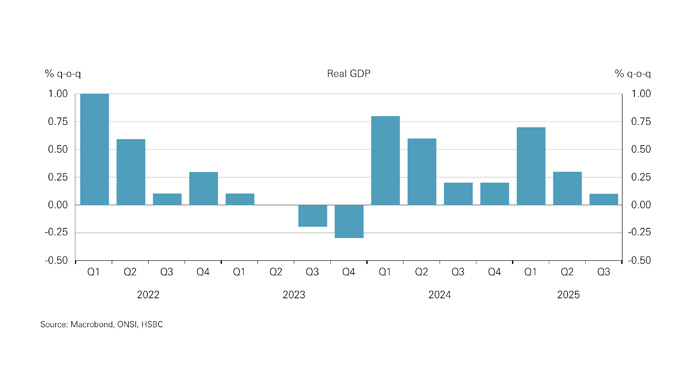
The months leading up to the UK Autumn Budget were clouded by high uncertainty and policy speculation, which appear to have contributed to a slowing in activity momentum. Indeed the PMI survey pointed to a slowing in growth in November with a notable downturn across the services sector, which reported a contraction in new order volumes. Notwithstanding that softness, against a backdrop of Budget uncertainty, activity surveys have been a less reliable signal of overall GDP growth, in fact, overestimating economic growth in Q3. The UK economy eked out a 0.1% q-o-q expansion in the third quarter as business investment fell and despite a small uptick in household consumption, a slowdown in government spending, which has been a driver of growth in recent quarters, weighed on overall growth.
It's possible that the economy sees a ‘bounce-back’ in the coming quarters. With the majority of fiscal tightening backdated into future years, the near-term outlook is little changed. While greater ‘headroom’ against the Chancellor’s fiscal targets should see a period of greater policy certainty, if that can translate into higher confidence then the UK could see some upside news in Q1 2026. Following the 2024 Autumn Budget and a weak H2 2024, Q1 2025 growth was robust at 0.7% q-o-q. But let’s be honest, given the low bar set in Q3 (and expected in Q4), some relatively more positive news early in 2026 shouldn’t be too difficult.
Higher unemployment and slower pay growth
Elsewhere, a weak demand backdrop and higher unit labour costs have seen a continued softening in the labour market throughout 2025. The unemployment rate rose to 5.0% in the three months to September and more timely payroll and survey data point to further headcount reductions in Q4. Private sector pay growth slowed to 4.2% 3m/yr in September and given the slack building in the labour market, we expect more muted pay pressures into 2026. However, a further increase in the National Living Wage to around 66% of median earnings and over 70% in some regions is new territory for the UK economy, while firms’ wage growth expectations have ticked higher in recent months, to 3.8%, up from 3.5%. Whether firms respond through headcount reductions or higher inflationary pressures, both are risks for the UK economy in 2026.
UK Autumn Budget: Economic need to knows for businesses
From a macroeconomic perspective there was very little in the Autumn Budget that was judged to bolster economic growth – the OBR went as far as explicitly saying so. As such, and despite higher government borrowing and expenditure in 2026, the OBR downgraded its annual 2026 GDP forecast to 1.4%.
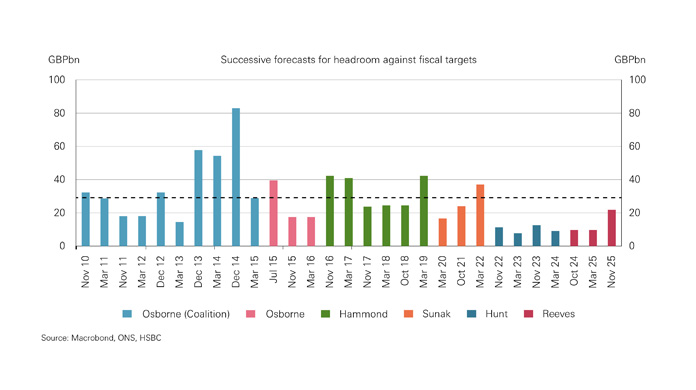
While a lack of substantial growth initiatives is a disappointment, the additional headroom against the main fiscal target to have the current budget balance in 2029/30 was welcomed. An increased margin of error from GBP9.9bn to GBP21.bn conditioned on a lower GDP growth path raises the bar for that headroom to be eroded and improves the resiliency of the UK to market or external economic shocks. Indeed, the market reactions in government bond yields and sterling have been positive.
However, the Budget did little to address the underlying challenges in UK public finances and therefore medium to longer term risks remain. Namely the prospect of further undershoots in the UK’s economic performance. Notably, despite the downgrade to productivity growth to 1.0%, the OBR remains more optimistic than other forecasters and the historical average. Moreover, with tax rises and some real-terms departmental spending cuts pencilled in for 2029/30, it raises the risk of ‘fiscal fictions’, i.e. whether those measures will be enacted when the time comes. To address those concerns, the government has announced its intention to bring forward passing legislation on some measures: at the time of writing, the cap for pension salary sacrifice at GBP2,000 appears to be the focus, alongside updated business rate valuation – both additional costs to firms in the coming years.
Download a PDF version of the report
Analyst Certification
The following analyst(s), economist(s), or strategist(s) who is(are) primarily responsible for this report, including any analyst(s) whose name(s) appear(s) as author of an individual section or sections of the report and any analyst(s) named as the covering analyst(s) of a subsidiary company in a sum-of-the-parts valuation certifies(y) that the opinion(s) on the subject security(ies) or issuer(s), any views or forecasts expressed in the section(s) of which such individual(s)is(are) named as author(s), and any other views or forecasts expressed herein, including any views expressed on the back page of the research report, accurately reflect their personal view(s) and that no part of their compensation was, is or will be directly or indirectly related to the specific recommendation(s) or views contained in this research report: Emma Wilks.
Important disclosures
This document has been prepared and is being distributed by the Research Department of HSBC and is intended solely for the clients of HSBC and is not for publication to other persons, whether through the press or by other means.
This document is for information purposes only and it should not be regarded as an offer to sell or as a solicitation of an offer to buy the securities or other investment products mentioned in it and/or to participate in any trading strategy. Advice in this document is general and should not be construed as personal advice, given it has been prepared without taking account of the objectives, financial situation or needs of any particular investor. Accordingly, investors should, before acting on the advice, consider the appropriateness of the advice, having regard to their objectives, financial situation and needs. If necessary, seek professional investment and tax advice.
Certain investment products mentioned in this document may not be eligible for sale in some states or countries, and they may not be suitable for all types of investors. Investors should consult with their HSBC representative regarding the suitability of the investment products mentioned in this document and take into account their specific investment objectives, financial situation or particular needs before making a commitment to purchase investment products.
The value of and the income produced by the investment products mentioned in this document may fluctuate, so that an investor may get back less than originally invested. Certain high-volatility investments can be subject to sudden and large falls in value that could equal or exceed the amount invested. Value and income from investment products may be adversely affected by exchange rates, interest rates, or other factors. Past performance of a particular investment product is not indicative of future results.
HSBC and its affiliates will from time to time sell to and buy from customers the securities/instruments, both equity and debt (including derivatives) of companies covered in HSBC Research on a principal or agency basis or act as a market maker or liquidity provider in the securities/instruments mentioned in this report.
Analysts, economists, and strategists are paid in part by reference to the profitability of HSBC which includes investment banking, sales & trading, and principal trading revenues.
Whether, or in what time frame, an update of this analysis will be published is not determined in advance.
For disclosures in respect of any company mentioned in this report, please see the most recently published report on that company available at www.hsbcnet.com/research. HSBC Private Banking clients should contact their Relationship Manager for queries regarding other research reports. In order to find out more about the proprietary models used to produce this report, please contact the authoring analyst.
- This report is dated as at 04 December 2025.
- All market data included in this report are dated as at close 03 December 2025, unless a different date and/or a specific time of day is indicated in the report.
- HSBC has procedures in place to identify and manage any potential conflicts of interest that arise in connection with its Research business. HSBC's analysts and its other staff who are involved in the preparation and dissemination of
Research operate and have a management reporting line independent of HSBC's Investment Banking business. Information Barrier procedures are in place between the Investment Banking, Principal Trading, and Research businesses
to ensure that any confidential and/or price sensitive information is handled in an appropriate manner. - You are not permitted to use, for reference, any data in this document for the purpose of (i) determining the interest payable, or other sums due, under loan agreements or under other financial contracts or instruments, (ii) determining the price at which a financial instrument may be bought or sold or traded or redeemed, or the value of a financial instrument, and/or (iii) measuring the performance of a financial instrument or of an investment fund