

- Article

- Support
- Economic Reports
- Market Research
Insights on the latest UK economic data
Consumer demand was boosted by the hot weather and the World Cup through June and July. The BoE left rates unchanged but pointed to the upside risks to, and uncertain outlook for, inflation. Meanwhile, PM Burnham announced some small policy changes, but the big tough decisions are yet to come.
A bit hot all round…
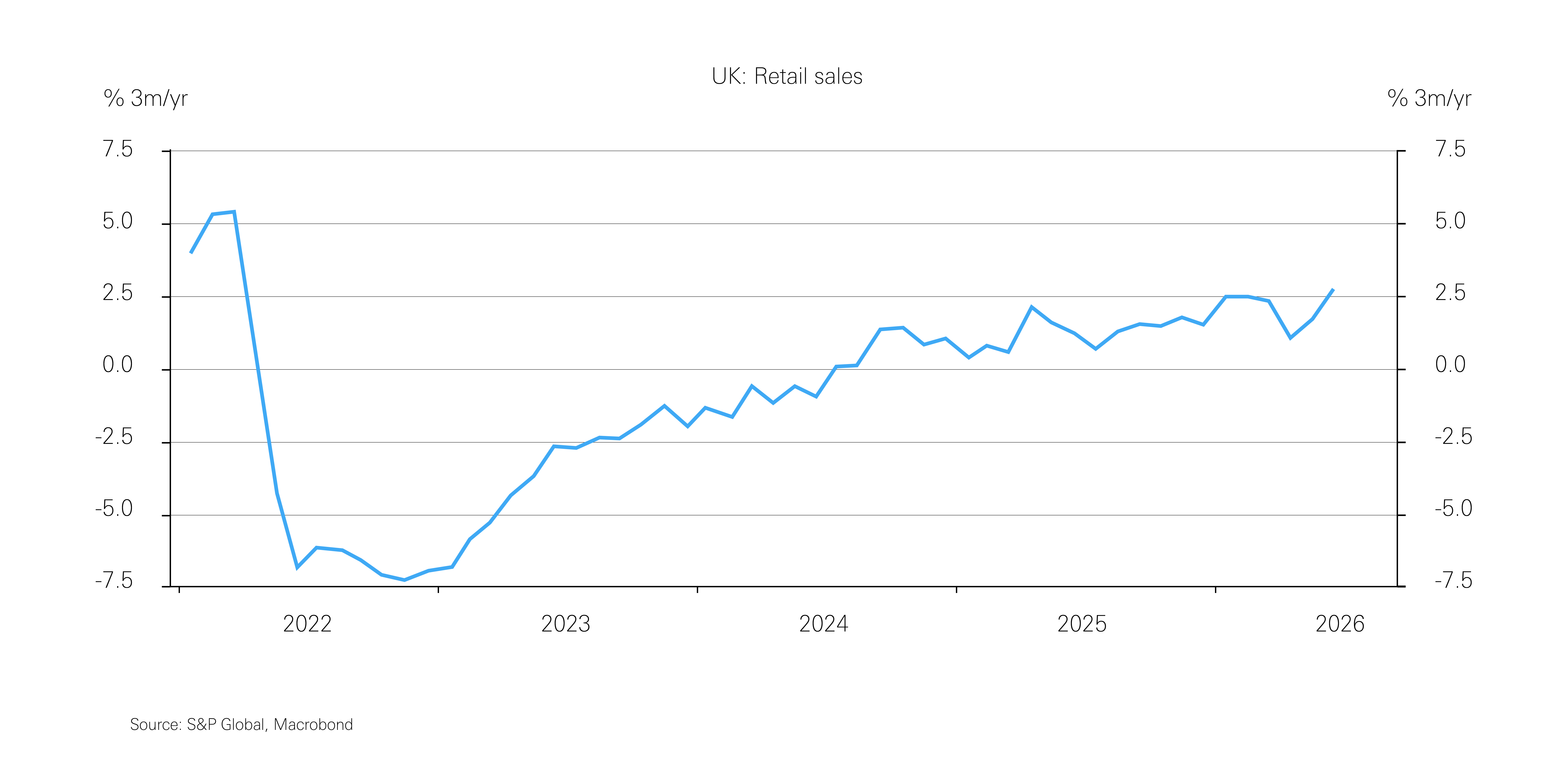
The UK economy entered the summer with decent consumer momentum, as we had expected in last month’s UK in Focus. Retail sales in June rose 1.0% m-o-m, bolstered by sales related to the hot weather and the FIFA World Cup. Notwithstanding those events, retail sales rose 2.6% 3m/yr (chart 1), likely supported by real income growth at +0.4% y-o-y in June, and a fall in the net inflow of cash savings year-to-date. However, the hot weather was cited as reducing footfall – online sales grew strongly – and fuel sales were down, despite lower prices.
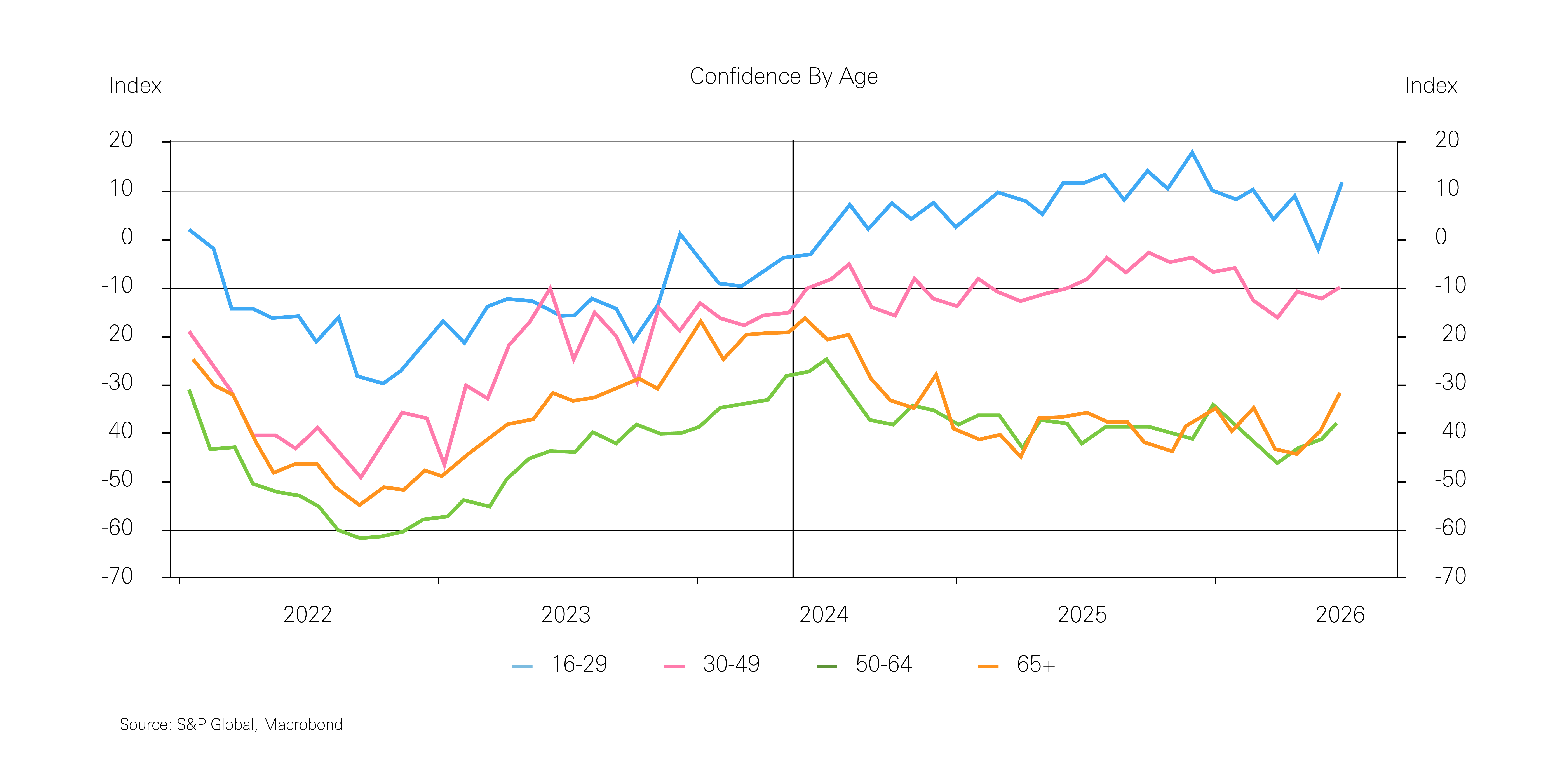
That said, the prospect, and change, of Prime Minister in July appears to have helped bolster consumer confidence, particularly across younger age cohorts. Meanwhile, business surveys reported improved activity in July, notably UK services PMI returned to expansion, manufacturers continued to report growth, but employment growth remained soft.
… but can it last?
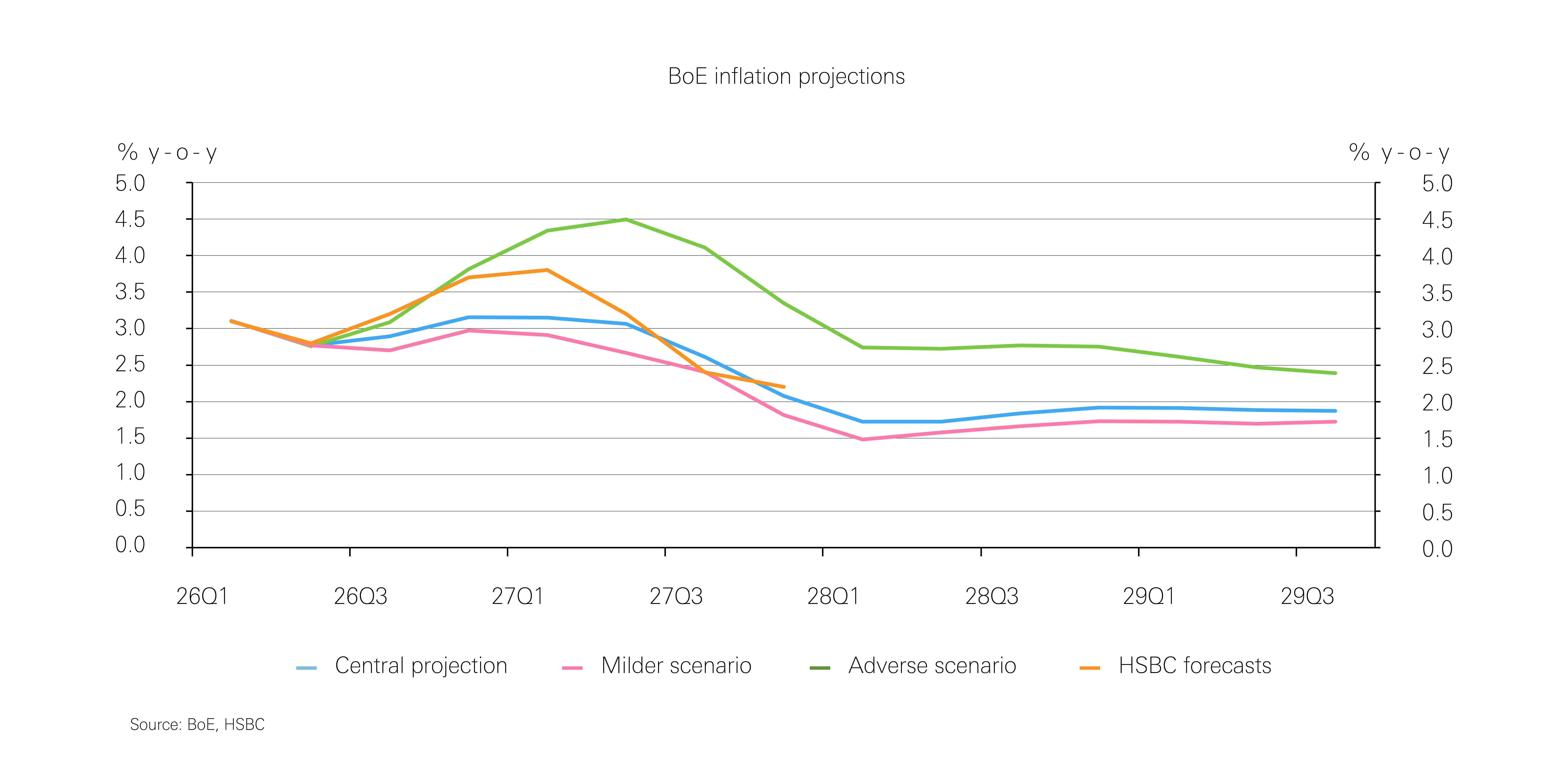
While a sizzling summer of activity is welcomed, some caution over its sustainability is warranted given the looming headwinds in the second half of the year. Importantly, for households, it will depend on the path of real income growth and the confidence to draw upon savings. On the former, inflation slowed to 2.6% y-o-y in June, but is set to rise to c3.7% in Q4 (chart 3), and with private-sector nominal wage growth expected to remain subdued, the squeeze in household budgets will tighten further, although if the savings rate falls faster than we expect, demand could remain relatively resilient. But we expect volatile conditions in the Middle East and uncertainty from domestic policymakers to keep a lid on any upside news on demand in H226.
Bank of England's mixed messaging
At its latest policy meeting, the Monetary Policy Committee, voted 6-3 in favour of leaving interest rates unchanged at 3.75%. Against a backdrop of global uncertainty, the tone of the committee was cautious and the risks to inflation were still judged to be on the upside. The BoE is vigilant to risk that the disruption in the Middle East sparks second-round inflation effects, ie, price rises ripple through non-energy sectors and into wage negotiations.
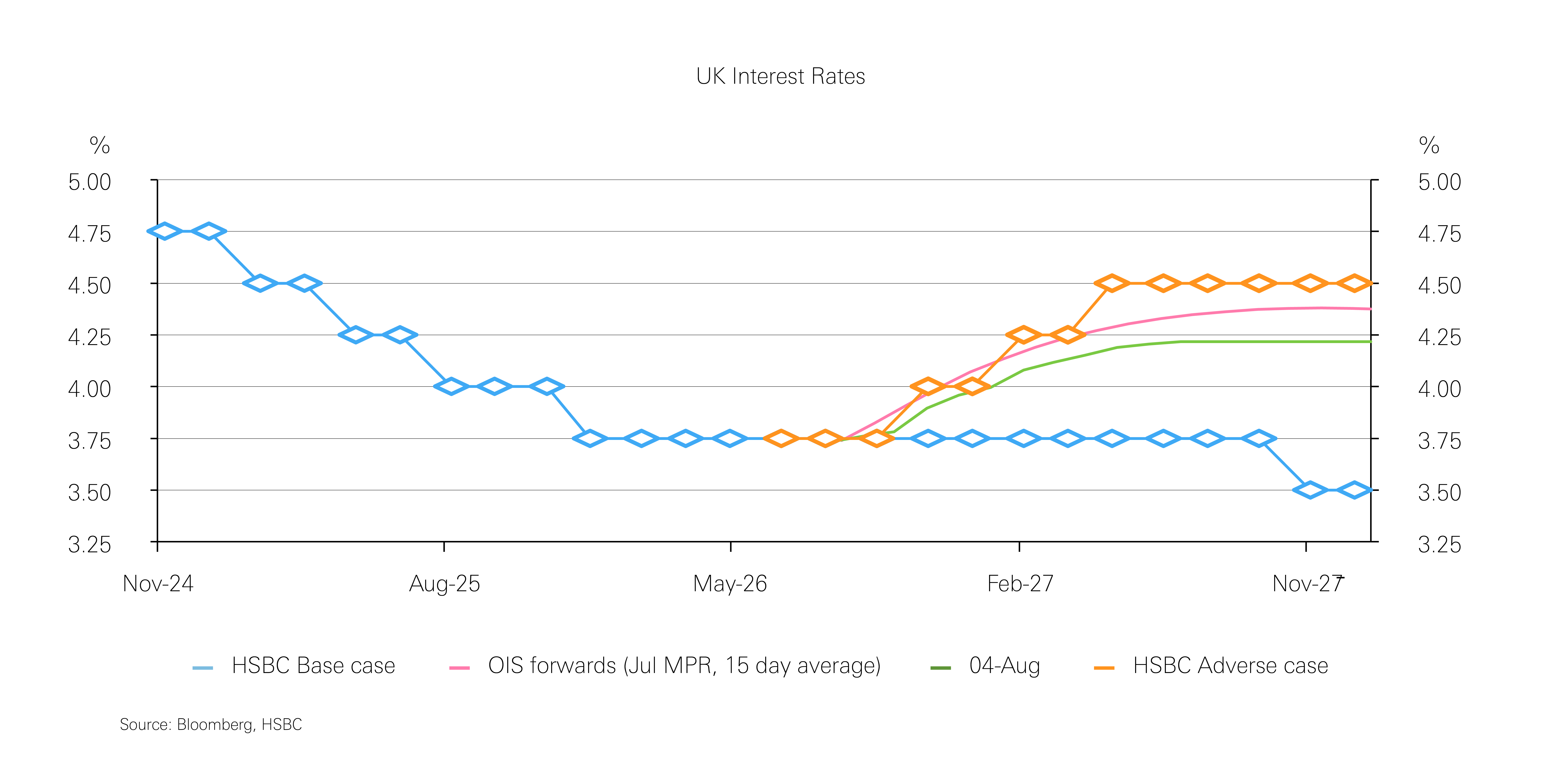
The challenge for policymakers is the time lag between an initial shock and evidence of secondround effects being visible. As such, the nine strong committee differ in their views over the scale of risk, but also to the correct course of action to mitigate the risk – act now, but risk unduly hurting the economy, or wait, and risk being late to contain inflation. We maintain our view, that the BoE would prefer to avoid hiking interest rates if it can and its own forecasts suggested that financial market rate expectations are high (chart 4). Indeed, Governor Bailey said the Bank was not “edging towards a hike", although that message is at odds with the additional vote from the MPC for a hike (6-3 vs 7-2 at its previous meeting).
…and a new government finding its feet
The new Prime Minister, Andy Burnham, hit the ground running with a series of policy announcements aimed at offering some households and businesses “breathing space”. While there were concerns over the funding of such policies, the costing is small relative to the broader challenges in the UK public finances. Indeed, before the new PM considers his ambitions and how to fund them, there are existing, expensive, issues to deal with, from defence, to pencilled in real-terms cuts in departmental spending in the coming years, and higher debt servicing costs. So, while the UK has a new PM and cabinet, the same challenges remain, and trade-offs will need to be made.
For now, financial market volatility has been sanguine, but an Autumn Budget scheduled on 28 October 2026 and a lack of detail on any objective (including social care and devolution) mean policy uncertainty could complicate this in the weeks to come.
This content and much more is available for you on the Global Investment Research and Research App (App Store | Google Play). For research questions, please email: AskResearch@hsbc.com
Analyst Certification
The following analyst(s), economist(s), or strategist(s) who is(are) primarily responsible for this report, including any analyst(s) whose name(s) appear(s) as author of an individual section or sections of the report and any analyst(s) named as the covering analyst(s) of a subsidiary company in a sum-of-the-parts valuation certifies(y) that the opinion(s) on the subject security(ies) or issuer(s), any views or forecasts expressed in the section(s) of which such individual(s)is(are) named as author(s), and any other views or forecasts expressed herein, including any views expressed on the back page of the research report, accurately reflect their personal view(s) and that no part of their compensation was, is or will be directly or indirectly related to the specific recommendation(s) or views contained in this research report: Emma Wilks.
Important disclosures
This document has been prepared and is being distributed by the Research Department of HSBC and is intended solely for the clients of HSBC and is not for publication to other persons, whether through the press or by other means.
This document is for information purposes only and it should not be regarded as an offer to sell or as a solicitation of an offer to buy the securities or other investment products mentioned in it and/or to participate in any trading strategy. Advice in this document is general and should not be construed as personal advice, given it has been prepared without taking account of the objectives, financial situation or needs of any particular investor. Accordingly, investors should, before acting on the advice, consider the appropriateness of the advice, having regard to their objectives, financial situation and needs. If necessary, seek professional investment and tax advice.
Certain investment products mentioned in this document may not be eligible for sale in some states or countries, and they may not be suitable for all types of investors. Investors should consult with their HSBC representative regarding the suitability of the investment products mentioned in this document and take into account their specific investment objectives, financial situation or particular needs before making a commitment to purchase investment products.
The value of and the income produced by the investment products mentioned in this document may fluctuate, so that an investor may get back less than originally invested. Certain high-volatility investments can be subject to sudden and large falls in value that could equal or exceed the amount invested. Value and income from investment products may be adversely affected by exchange rates, interest rates, or other factors. Past performance of a particular investment product is not indicative of future results.
HSBC and its affiliates will from time to time sell to and buy from customers the securities/instruments, both equity and debt (including derivatives) of companies covered in HSBC Research on a principal or agency basis or act as a market maker or liquidity provider in the securities/instruments mentioned in this report.
Analysts, economists, and strategists are paid in part by reference to the profitability of HSBC which includes investment banking, sales & trading, and principal trading revenues.
Whether, or in what time frame, an update of this analysis will be published is not determined in advance.
For disclosures in respect of any company mentioned in this report, please see the most recently published report on that company available at www.hsbcnet.com/research. HSBC Private Bank clients should contact their Relationship Manager for queries regarding other research reports. In order to find out more about the proprietary models used to produce this report, please contact the authoring analyst.
- This report is dated as at 4 August 2026.
- All market data included in this report are dated as at close 3 August 2026, unless a different date and/or a specific time of day is indicated in the report.
- HSBC has procedures in place to identify and manage any potential conflicts of interest that arise in connection with its Research business. HSBC's analysts and its other staff who are involved in the preparation and dissemination of Research operate and have a management reporting line independent of HSBC's Investment Banking business. Information Barrier procedures are in place between the Investment Banking, Principal Trading, and Research businesses to ensure that any confidential and/or price sensitive information is handled in an appropriate manner.
- You are not permitted to use, for reference, any data in this document for the purpose of (i) determining the interest payable, or other sums due, under loan agreements or under other financial contracts or instruments, (ii) determining the price at which a financial instrument may be bought or sold or traded or redeemed, or the value of a financial instrument, and/or (iii) measuring the performance of a financial instrument or of an investment fund