
- 5 minutes
- Article
- Innovation & Transformation
- Improve Efficiency
- Digital Adoption
Meet the manufacturing Trailblazers taking on sustainability challenges

Created by WIRED Consulting in partnership with HSBC UK
These three businesses are making a difference through smart thinking. Here’s how…
British manufacturing continues to show resilience and strength: it is worth £217 billion to the UK economy a year, supporting more than 2.6 million jobs¹, and the UK remains the 12th largest manufacturer in the world², a key player in a sector worth $14 trillion globally.
Yet precisely what the UK is making has shifted in recent years. There has been a steady growth in advanced manufacturing sectors, a key focus of the government's Industrial strategy, alongside areas such as clean energy and life sciences. “Some of the most interesting and innovative manufacturing businesses are solving the big problems,” says Rohit Moudgil, Head of Manufacturing & Industrials at HSBC UK.
Some are reinventing the way we live our lives; others are reimagining how we make things in the first place. And many have missions that are laudable – like these Trailblazers who are all focussing on sustainability issues. Perhaps they’ll inspire what challenge you take on next…
The challenge: Flue gas emissions from factory chimneys
Flue gas is a collective waste product from much manufacturing. Reducing or removing certain chemical compounds such as carbon dioxide from it could be critically beneficial for the environment.
Who’s working on it? Promethean Particles
Promethean Particles specialises in the manufacture of metal-organic frameworks (MOFs). These crystalline chemical compounds, which appear as a powder to the human eye, “hold astonishing potential,” says James Stephenson, CEO of Promethean.
MOFs are a class of material with molecule-scale, regular gaps in their lattice-like structure. When these are synthesised, their design can be “tuned” to precisely trap certain molecules like carbon dioxide while allowing other substances – nitrogen or water vapour, say – to pass through. A notable quality of MOFs is their massive surface-area-to-volume ratio, which means they can trap large quantities of molecules. If unfurled, Stephenson explains, a single teaspoon of these materials could cover two football fields. If produced cheaply at scale, MOFs could be used to adsorb emitted carbon dioxide from flue gas chimneys.
Promethean has engaged in partnerships with AI companies to speed up the development of new, more effective and cheaper-to-produce MOF structures to be made in bulk. “If MOFs are going to put a dent in removing carbon emissions,” says Stephenson, “we’re probably going to need hundreds of thousands of tons of material.”
The challenge: Maritime transport’s carbon footprint
Slow-moving shipping craft are actually more efficient than smaller, faster ones. If we’re to embrace the cleaner movement of goods and people, decarbonising smaller craft is essential.
Who’s working on it? Artemis Technologies
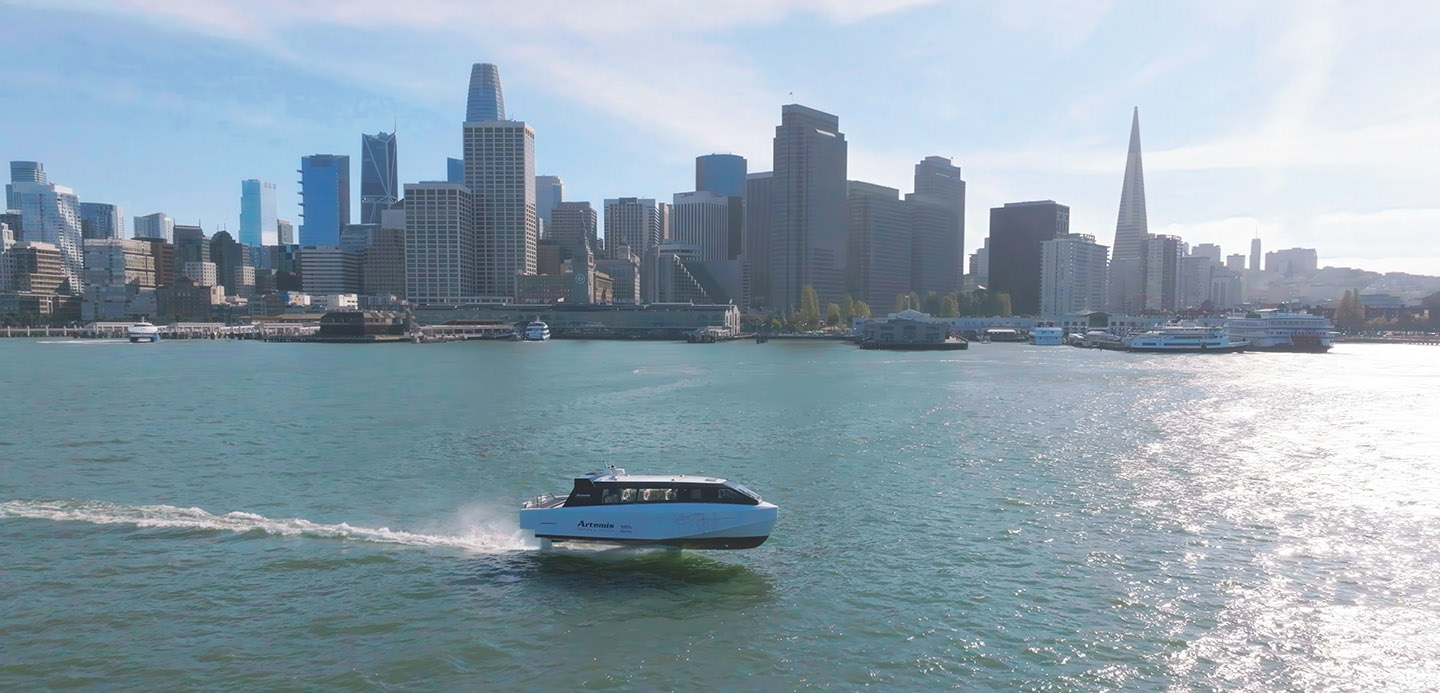
An ex-professional sailor, Dr Iain Percy founded Artemis Technologies to manufacture “eFoiler” hydrofoils for the commercial maritime industry.
Hydrofoil vessels “fly” above water, reducing drag by over 90 per cent, cutting energy demands and boosting speeds. While hydrofoils themselves are relatively well established, Artemis Technologies’ eFoiler system is entirely electric, and uses an AI-powered sensor to adjust the height of the foil, keeping the craft level and resulting in a smoother, more efficient journey. For a high-use, short-distance vessel like the 150-passenger Red Funnel Isle of Wight ferry (an Artemis Technologies client), some 8,000 tonnes of CO2 can be saved a year.
Dr Percy and his team are expanding into the US, Asia and the Middle East, and have a run of collaborations with maritime companies in the pipeline. Should these prove successful, Percy hopes that Artemis eFoiler craft will start to become the norm for small and medium boats.
The challenge: Ocean-bound plastic pollution
Ocean-bound plastic is a major source of pollution. But discarded plastic, mixed together and left behind with other waste, is almost impossible to recycle. To be recycled at scale, plastic has to be carefully sorted, which requires infrastructure.
Who’s working on it? Prevented Ocean Plastic
Prevented Ocean Plastic helps develop recycling facilities in regions with high levels of ocean-bound plastic, such as East Africa, Southeast Asia and Latin America.
The organisation partners with local entrepreneurs and recyclers, helping them build or upgrade sorting and collection facilities. These centres employ and train local people to collect and sort plastic – predominantly PET – into high-quality feedstock, which is then recycled into traceable plastic for large-scale manufacturing. This material is then sold, generating value for local communities while reducing pollution.
That’s not all. In tandem with a handful of brand and manufacturing partners, Prevented Ocean Plastic has developed a process that allows discarded polypropylene to be recycled into food-safe plastic that meets European safety standards for the first time ever.
“In reality, up until now, less than one per cent of polypropylene globally has been recycled,” says founder Raffi Scheier. “Now we can finally have the world's first polypropylene cup that turns into another polypropylene cup.”